
Tax, audit & accounting firms are moving beyond hours to outcomes, using tiered packages and subscriptions to align fees with value, boost confidence, and deepen client loyalty; and this shift is bringing predictability, clearer narratives around impact, and a scalable way for clients to personalize services without chaos
Key takeaways:
-
-
-
Subscriptions are a high-value option — Subscription-led pricing correlates with the highest value confidence and steadier revenue compared to hourly or fixed-fee models.
-
Three pricing packages evolve — Three tier packages (basic, standard & premium) create a clear value ladder and enable increased customization through modular add-ons.
-
Regular billing cycles help — Monthly or quarterly billing cadences improve transparency, client trust, and firm cash flow.
-
-
Tax, audit & accounting firms are in the middle of a pricing reckoning. Clients want clarity, firm leaders want confidence, and teams want to escape the treadmill of selling hours. The firms pulling ahead aren’t just raising rates, they’re re-engineering how they define and deliver value. Packaging, bundling, and especially subscription-based pricing are allowing firms to price with conviction, increase margins, and deepen client loyalty. The shift is not cosmetic, rather it’s a strategic reset from billing for hours to being paid for outcomes instead.
The confidence advantage of subscriptions
According to the recent Thomson Reuters Instiitute’s 2025 Tax Firm Pricing Report, firms that have adopted subscription billing for most clients, tax professionals’ confidence in the value they’re providing is materially higher than when hourly or fixed-fee pricing models are used. Indeed, nearly one-third of tax professionals in subscription-first firms say they are highly confident that their pricing aligns with the value delivered, compared to less than 20% of those professionals in firms that use in hourly pricing.
Why the gap? Subscription pricing models reframe the client relationship around results, not individual tasks. These models anchor expectations, create continuity, and prompt ongoing conversations about progress and outcomes. They also bring predictability — steady revenue for the firm and transparent costs for the client.
Conversely, hourly and even traditional fixed-fee pricing models struggle to tell that story. They describe inputs and deliverables, while subscriptions describe impact.
Despite the benefits, firm adoption of subscription pricing is still in its early stages. Only a small portion of client engagements are currently based on subscriptions, although that share is growing rapidly. This gap is an opportunity for many tax, audit & accounting firms and their leaders. Indeed, the invitation is clear: Firm leaderss should identify those offered services in which outcomes compound over time — such as tax planning, strategy, compliance along with advisory — and transition those into ongoing, subscription-based relationships with clients.
Design services like products: The 3-tiered architecture
Modern pricing gains power from clarity. That’s why the most effective firms are organizing their services offering catalog into three simple tiers — basic, standard, and premium — which then allows for additional customization through modular add-ons.
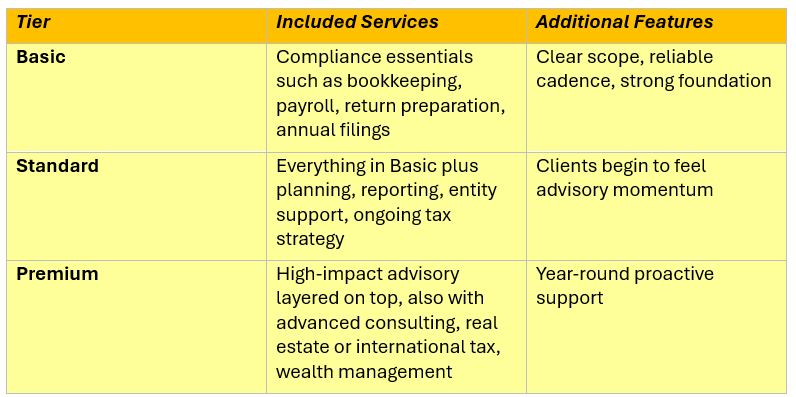
This architecture does three things well: First, it creates a value ladder that allows firms to guide their clients to the right entry point while giving them a clear path to upgrade; second, it standardizes delivery, improving margins and team efficiency; and third, it enables customization without chaos.
Rather than reinventing a customized scope for each client, firms use defined add-ons — education planning, entity structuring, succession planning, and more — to tailor engagements to the client while maintaining operational consistency across all services.
Earning (and keeping) your fee increases
The best-performing firms aren’t timid about fees. They’re raising prices — and keeping clients — because they’ve reframed the value conversation. Instead of talking about more hours or complexity, they instead talk about the kind of outcomes that clients actually care about: peace of mind, risk reduction, strategic clarity, and measurable savings. The tax professionals bring real examples, case studies, and ROI to the table, and they benchmark. They review pricing annually or even quarterly, and they communicate changes to their clients in a way that feels transparent, justified, and aligned with client goals.
This is a pivotal shift for many tax, audit & accounting firms. The professionals at these firms have learned that when clients understand the outcome, the price makes sense; and when they don’t, the conversation reverts to cost. Packaging and subscriptions make this communication repeatable. In this environment, tiers create contrast, add-ons create choice, and benchmarks create external validation. Together, these factors shift the dialogue with clients from How much? to What’s the impact? — and that’s a win for firms.
Predictability is a service
If trust is the currency of advisory work, predictability is the interest it earns. Monthly or quarterly billing rhythms can reduce friction, improve cash flow on both sides, and transform tax from a once-a-year scramble into an ongoing partnership. Sending out clear, consistent invoices mapped to packages and add-ons can reinforce the story of value delivery. Internally, predictable revenue can smooth seasonality within a firm, supporting hiring and capacity planning, and reducing the temptation to discount prices under pressure.
Customization at scale
Clients want to feel known, and your tax team needs to stay sane. The answer isn’t to create bespoke products for everything, rather it’s to encourage segment-smart design. Build packages for common client profiles by industry, entity type, size, or lifecycle stage, then equip your team with modular upgrades that align to clear outcomes. This allows tax advisors to make confident recommendations, identify retention risks early, and adjust scope based on profitability and feedback — all without blowing up workflows.
Think like a product organization: Define standard features, articulate premium benefits, and maintain a disciplined roadmap of add-ons. Then enable your tax advisors with a playbook — which clients get what, when, and why — so the client experience feels personal while the back office remains efficient.
A practical path to transition
If you’re ready to move from hours to outcomes, you should start with focus and speed. Here are several steps that can help:
-
-
- Choose the right beachhead — Identify one or two services that are ideally suited for ongoing value, such as monthly accounting plus tax, annual planning with quarterly check-ins, or entity support and then package those services into clear tiers.
- Build the narrative — For each tier, translate features into outcomes. Replace X reconciliations and Y reports with real-time visibility, faster decisions, and fewer surprises. Back this effort with case studies and quantified savings wherever possible.
- Set billing cadence and service-level agreements — Decide what services can be billed monthly compared to quarterly, define response times and access levels per tier, and codify communication rhythms. Make service levels visible, because again, clients value clarity.
- Pilot, then expand — Roll out your initial offerings to a defined client segment or cohort. Collect feedback, refine scope, and test pricing elasticity. Use early wins to train your team and inform a broader rollout.
- Institutionalize benchmarking and reviews — Compare your pricing against peers and alternative service providers at least annually. Review client outcomes quarterly and then adjust tiers, add-ons, and messaging based on what you learn.
- Equip your team — Give your tax advisors scripts, ROI calculators, and objection-handling guidelines. Realize that confidence is contagious, both internally and externally.
-
Shifting from selling time to selling outcomes requires more than a new price list. It asks firm leaders to design services intentionally, measure impact consistently, and coach their teams to speak the language of results. It also asks firms to treat pricing as strategy, not administration. Firms should be explicit about what clients they serve, what they promise, and what it’s worth.
The firms that make this shift will do more than improve margins. They’ll build sturdier client relationships, reduce scope creep, and cultivate a culture in which the team understands — and can articulate — the value they create. In a world in which talent is tight and client expectations are rising, that kind of intentional clarity can be a strong competitive advantage.
You can download a full copy of the Thomson Reuters Institute’s recent report on tax firm pricing, Steps for increased confidence in pricing, here