Brazilian tax firms are showing improved readiness for the reform compared to last year, but many still face potential challenges — and even with a strong focus on technology, some may be overlooking critical areas like staff training and client support, which are essential for a well-rounded transition
Key findings:
-
-
-
-
Strategic blind spots remain — Despite widespread awareness, many tax firms have yet to fully assess the operational or financial impact of the reform, highlighting the need for more proactive planning as changes approach.
-
Technology investment leads the way — Firms are prioritizing technology and now are beginning to complement these efforts with increased attention to staff training and client support, aiming for a more balanced and complete transition.
-
Client guidance is gaining momentum — While clients will be among the most affected, professionals are recognizing the urgency of providing clearer communication and tailored support to help clients navigate the reform more confidently.
-
-
-
Brazil’s tax, audit & accounting sector is on the verge of a historic transformation. The country’s new tax reform, approved by the National Congress, will gradually unify several existing taxes into a dual value-added tax (VAT) system. The reform aims to simplify compliance, promote transparency, and help citizens better understand how public resources are allocated.
Jump to ↓
Brazil Tax Reform for Tax Firm Professionals 2025
So how prepared are Brazil’s tax & accounting professionals for this upcoming shift? A new report from the Thomson Reuters Institute reveals a gap between awareness and action. While most professionals understand the reform and its implications, only a minority have moved into active preparation. Only a small group of firms have established internal teams or concrete plans; however, many others are now beginning to shift from passive monitoring to more decisive steps.
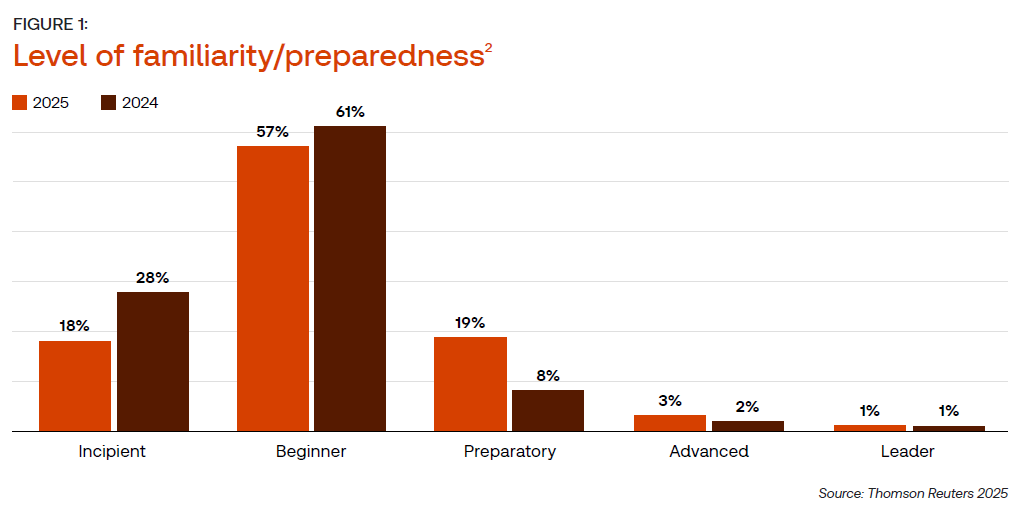
Definitions: Incipient: I am aware of the Tax Reform, but I am not keeping up with the changes. Beginner: I am following updates through the press and reports to evaluate information that fits the firm’s and customers’ profile. Preparatory: I have an internal working group and/or a developing plan. Advanced: I have allocated resources and a transition project in progress. Leader: I have the structure prepared for the transition and I am working with my team and external providers to anticipate our adaptation.
The reform is expected to impact core areas of tax, audit & accounting work — including tax calculation, pricing strategies, and advisory services. Professionals widely acknowledge these areas will be disrupted and are starting to take steps to assess and prepare for the changes. Technology investment is accelerating, with many firms upgrading systems and digital infrastructure to meet new requirements. At the same time, there is growing recognition that staff training and client education must advance in parallel to ensure a successful transition.
Many professionals have expressed a need for more resources and structured plans to help them guide clients through the reform, especially as they face changes in tax burdens, pricing structures, and compliance requirements. Encouragingly, firms are beginning to respond — developing communication strategies and training programs to better support both their teams and their clients.
You can download a full copy of the Thomson Reuters Institute’s “Brazil Tax Reform for Tax Firm Professionals 2025” in Portuguese here
One major area still evolving is the financial planning around the reform. Despite the potential for significant operational changes, most organizations have yet to estimate the cost of adaptation. As new requirements take effect, understanding and preparing for these costs will be essential to avoiding unexpected disruptions.
Opinions on the reform’s complexity remain divided. Some professionals expect simplification, while others anticipate greater difficulty in tax and accounting practices. This uncertainty only reinforces the importance of ongoing monitoring and the development of flexible strategies.
While technology remains a central focus, the sector is now beginning to align its efforts — recognizing that human capabilities and client engagement are equally essential. The transition is no longer just about systems and infrastructure, but also about empowering their professionals and building trust. Firms are taking steps to ensure that their teams are prepared and their clients are supported, thereby laying the groundwork for a more complete and resilient transformation.
You can download
a full copy of the English-language version of the Thomson Reuters Institute’s “Brazil Tax Reform for Tax Firm Professionals 2025” by filling out the form below: