
Given rising costs and client demands, many tax firms are struggling with maintaining pricing confidence — yet, data benchmarking provides a way forward, says a recent Thomson Reuters Institute report, but only with the right data infrastructure to properly analyze the data
Key takeaways:
-
-
-
Pricing strategy is paramount — Rising operational costs and client demands for value are squeezing tax firms’ margins, making confident pricing strategies more important than ever.
-
Data seen as the answer — Many tax firm leaders lack high confidence in their pricing strategy, and as a result are seeking better market intelligence and benchmarking data to improve their approach.
-
Underlying data systems are necessary — Investing in robust technology and data architecture is essential for firms to fully leverage data-driven pricing strategies and maximize value.
-
-
Today’s tax, audit & accounting firms are in a state of financial flux: Operational costs continue to rise, and firms are raising rates in response, while at the same time, clients — under their own cost pressures — are increasingly looking for their outside firms to demonstrate clear value for the services they provide.
In practice, this creates a squeeze on tax firms’ margins. In fact, our research from earlier this year shows that while almost two-thirds (64%) of tax firm professionals survey said their firms have increased revenues in the past 12 months, less than half (45%) had actually increased profits over that same time span.
The result is that many tax firm leaders are not fully confident in their pricing strategy. Indeed, only about one-third (19%) of tax-firm decision-makers say they are highly confident that their pricing reflects the value of the expertise provided, according to a new report on tax firm pricing from the Thomson Reuters Institute, Steps for increased confidence in pricing. The majority of respondents (53%), meanwhile, say they feel just moderately confident, while 26% feel either not very confident or not at all confident about matching pricing to value.
Naturally, tax firm leaders want to increase their confidence in how they are pricing matters. And, perhaps unsurprisingly in the current age of AI, they are increasingly turning towards data-driven solutions to close this gap. Those firm leaders investing heavily in technology to aid pricing strategy should be aware, however, that data analytics are not a set-it-and-forget-it proposition. True market intelligence should be part of a broader data architecture plan to make sure outputs and results are both trusted and accessible.
Data as the key
Given that how matters are priced directly contributes to the firm’s bottom line, some firm leaders have taken a surprisingly hands-off approach to the question of how much to charge. The report found that many tax firms have adopted a simple mantra: If clients are happy, we’re happy.
As one respondent wrote: “If they don’t complain and pay us, we assume that they see our pricing as fair and competitive.” Another reflected similar sentiments, adding that in the current marketplace, their firm will “charge what we charge, and if clients do not want to pay our rates, we move on as we are already too busy.”
However, this approach only allows for the status quo, rather than actually maximizing the value of the services offered. Or, to put it another way: Firms are potentially leaving money on the table by not performing more analysis on the correct prices and pricing model to offer their clients.
Even those firm leaders who want to perform this sort of pricing analysis may not have the capability to do so, however. When asked what would make them have more confidence in their pricing strategy, the top answer by a wide margin was the desire for more market intelligence and benchmarks.
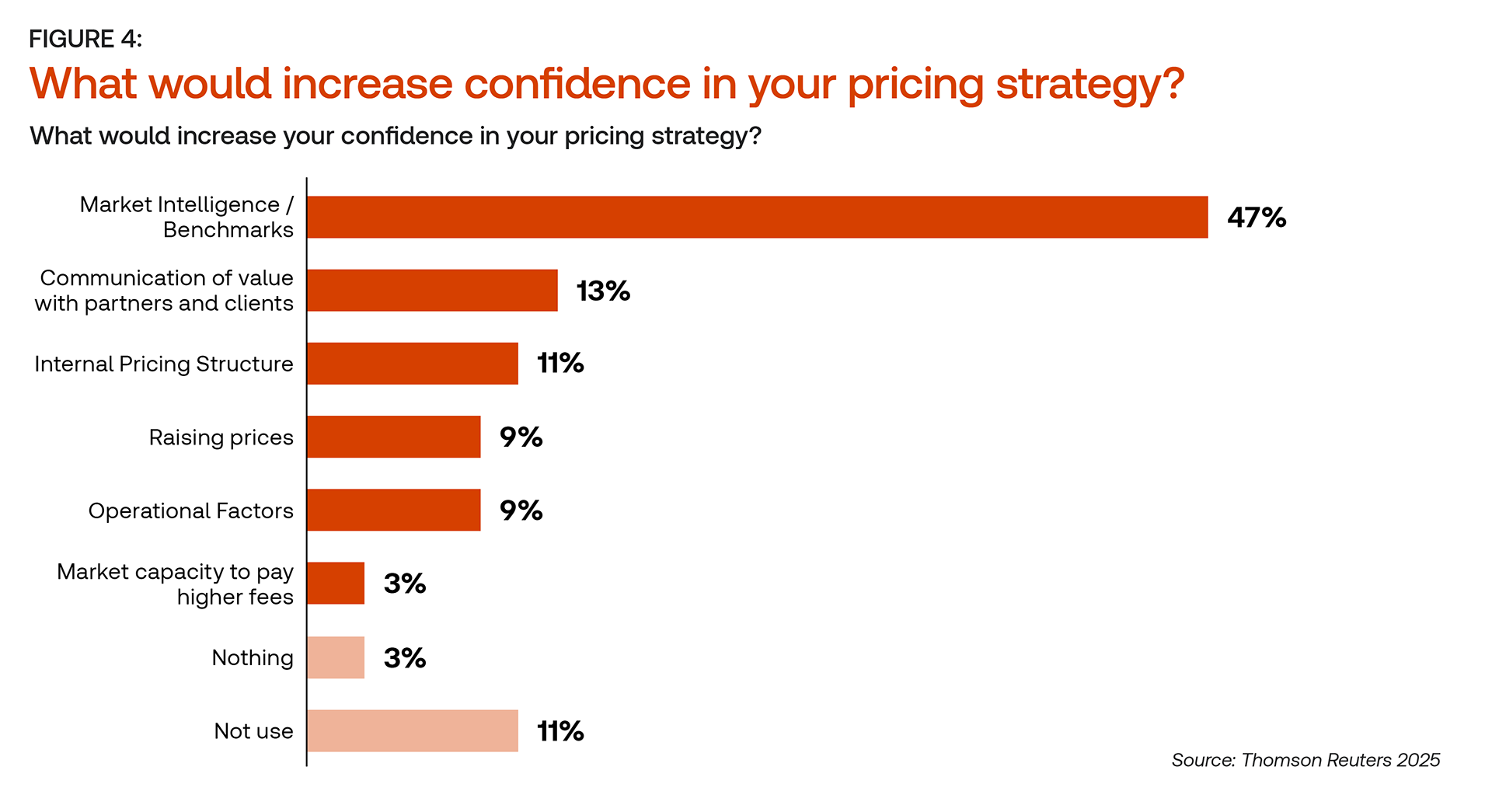
This market intelligence could come in the form of more information around what other similarly situated tax firms are charging their clients. As one survey respondent noted: “We have spotty pricing information from other firms.”
This could also mean gathering more information about the type of pricing models used. For example, the survey found that firms using subscription models felt more confident overall in their pricing when compared to firms primarily using hourly or fixed rates.
This creates a rather simple maxim: The more information tax firm leaders have around their competition, the more confidence they’ll have in their pricing strategy. However, actually implementing this type of data strategy to aid pricing can be easier said than done.
Laying the foundation
A separate Thomson Reuters Institute report from late 2024, the Tax Firm Technology Report, found that while firms as a whole are working to increase their technology posture, many still lack fully robust technology systems. While nearly half of the respondents surveyed for that report called their position on the technology curve proactive, just 10% called it optimized or predictive. The majority also rated their firm personnel’s tech competency between 6 and 8 out of 10, with training around technology only occurring in about half of firms.
Further, particularly as it relates to data analytics, many tax, audit & accounting firms (particularly smaller firms) don’t have the underlying systems in place to easily be able to collect and disseminate pricing and client data. According to the report, just 59% of respondents say their firms have firm or practice management systems, 57% have client collaboration or portal systems, and 45% have tax workflow or project management systems.
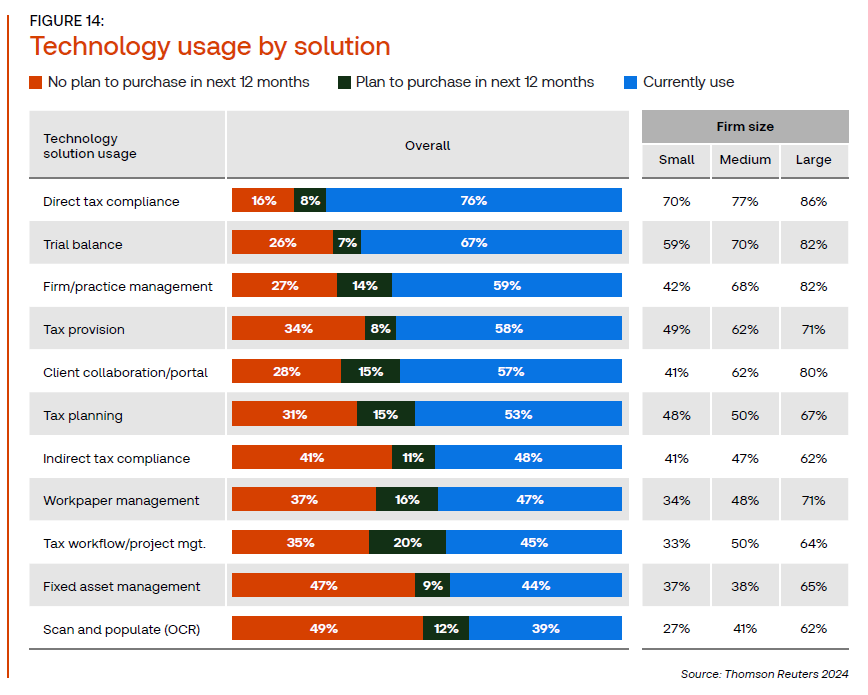
When used properly, data does not exist in a vacuum. Data comparisons can be made by simply analyzing other firms’ prices on a spreadsheet, which can work as a starting point. However, the most successful firms are quickly moving past the spreadsheet as the primary form of analysis. The type of pricing information that many of today’s firm leaders desire requires multiple types of inputs and systems for making that data portable. Proper analysis requires an underlying technology architecture before it is useful.
In order to be fully confident around extracting the most value out of pricing, the next generation of successful firms will be the ones that use tech systems to draw comparisons based on types of matters and pricing models; draw feedback from clients around what works best for all parties, and utilize AI and other technologies in a predictive manner to aid decision-making, especially as to which specific pricing models will provide the most value.
Data-driven benchmarking can provide more confidence for a tax firm’s pricing strategy, however, proper data hygiene and architecture are necessary initial steps that need to be undertaken before firms can get to their desire point.
You can download a full copy of the Thomson Reuters Institute’s recent report on tax firm pricing, Steps for increased confidence in pricing, here