
Professional services employees are experimenting with AI tools but face unclear policies and a lack of meaningful feedback on their efforts.
Key insights:
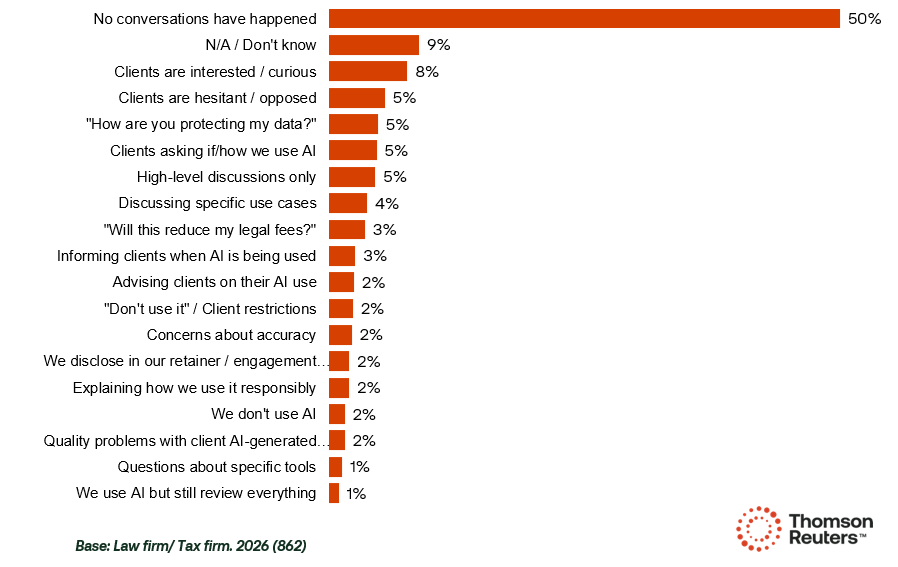
- Employees face contradictory messages or none at all — Nearly 40% of professionals surveyed report receiving conflicting directives about AI usage from clients and leadership, while half report no client conversations about AI have occurred at all.
- Workers lack feedback on whether their AI efforts matter — Professionals who are experimenting with AI tools without knowing if their efforts are valued are left uncertain about whether investing time in developing AI skills is worth it.
- Job displacement fears are rising — While employees remain cautiously optimistic about AI usage in their workplace, concerns about job displacement have doubled over the past year.
As generative AI (GenAI) tools flood into legal and accounting workplaces, organizations are deploying powerful technology without giving their employees clear directions on how to use it. Worse, some have received no guidance.
New research that underpinned the recent 2026 AI in Professional Services Report from the Thomson Reuters Institute (TRI), reveals a disconnect between AI availability and organizational guidance, which is creating confusion that may undermine both employee experience and the technology's potential value. (The report's data was gathered from surveys of more than 1,500 legal, tax, accounting, and compliance professionals across 26 countries.)
Employees navigate inconsistent AI policies or none at all
Approximately 40% of the professionals surveyed said they received contradictory guidance from clients and leadership about AI tool usage, with directives both encouraging and discouraging their use on projects and in RFPs. This ambivalence is slowing down decision-making at the front lines — a place in which AI could deliver the most value.
Equally concerning is the fact that half of professionals indicated that no conversations with clients about AI tool usage have taken place yet. And when discussions do occur, concerns about data protection and accuracy are the main topics.
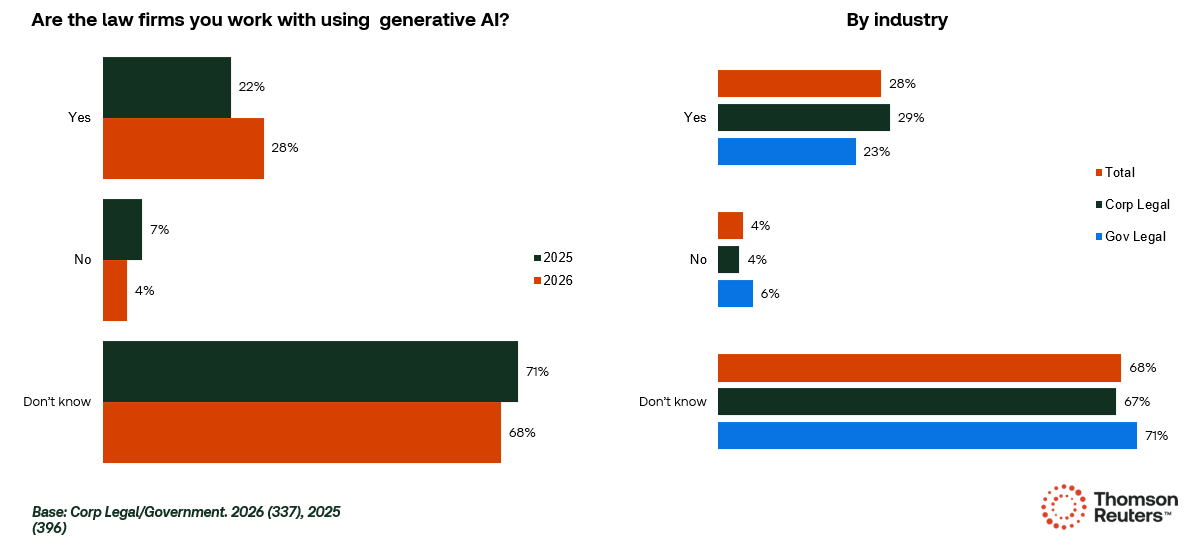
This confusion extends to external relationships as well. More than two-thirds of corporate and government clients remain unaware of whether their outside professional service providers are even utilizing GenAI. And the majority of clients have provided no direction whatsoever to their outside law firms concerning AI use, respondents said.
Organizations often ignore what employees need to know
Perhaps most revealing is how organizations are measuring — or failing to measure — whether their AI investments are paying off. Almost half of respondents said their organizations are not measuring return on investment (ROI) at all. Among the minority (18%) of respondents that said their organizations do track ROI, the metrics they use tell a story about organizational priorities. That fact that internal cost savings and employee usage rates lead the list suggests a focus on efficiency over innovation or quality improvements.
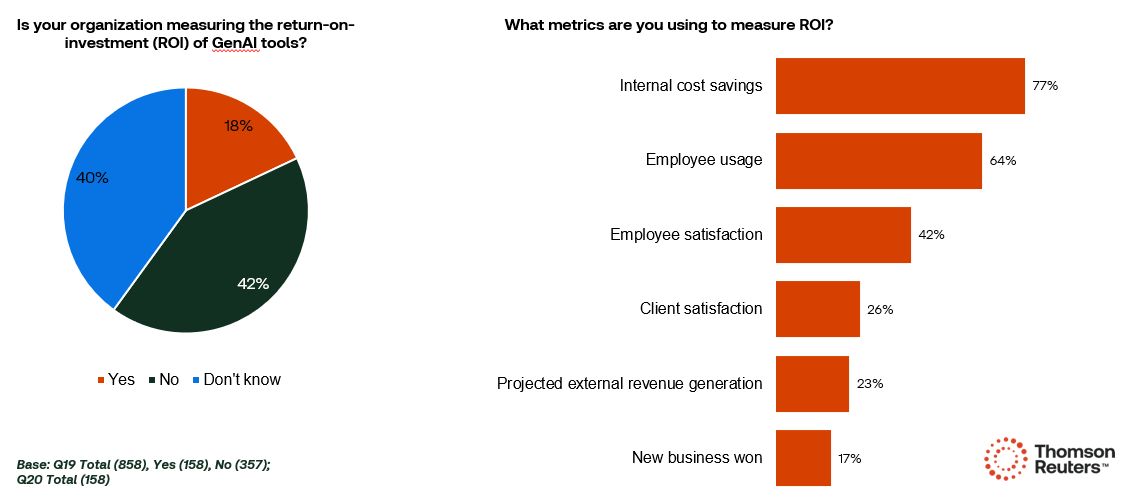
This measurement vacuum has consequences for employee experience. Without clear success metrics, employees lack feedback on whether their AI experimentation is valued, discouraged, or even noticed. The absence of ROI frameworks also makes it hard to justify training investments or dedicated time that allows employees to develop AI fluency.
AI usage doubles while support systems fall behind
AI usage among professional service organizations has nearly doubled over the past year, and professionals are increasingly integrating these tools into their workflows, the report shows. Yet organizational infrastructure that could support this adoption surge lags badly. Most professionals said they expect GenAI to become central to their work within the next two years — but that may be happening without roadmaps from their employers.
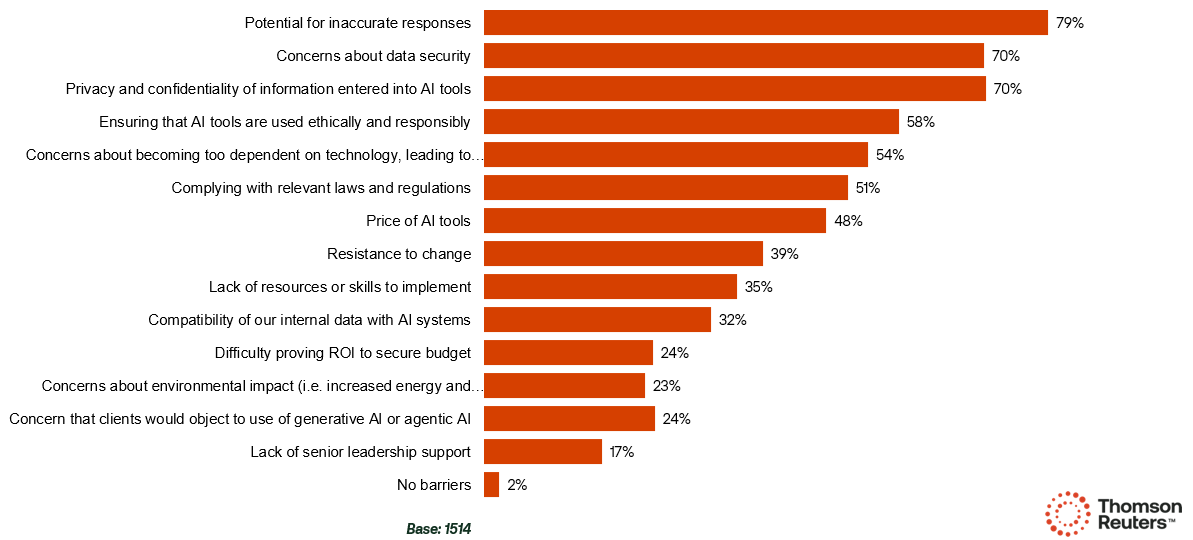
In addition, notable barriers in employees' usage of AI remain. When asked what barriers could prevent their organization from more widely adopting GenAI and agentic AI, almost 80% of professionals cited concerns over inaccurate responses. Other concerns included worries over data security, privacy, and ethical use. Most of these suggest an ongoing lack of trust in GenAI.
The tool landscape adds another layer of complexity. Publicly available tools dominate current usage, with more than half of respondents (57%) citing their use, while proprietary or industry-specific solutions remain largely in the consideration phase. This suggests employees are often self-provisioning AI tools rather than working within enterprise-supported ecosystems. This potentially opens organizations to increased risk exposure because of security gaps, compliance risks, and inconsistent quality.
Employees' job displacement fears increasing
Despite these challenges, employee sentiment toward AI remains cautiously optimistic. More than half (57%) of respondents said they are either hopeful or excited about the future of GenAI in their industry. Clearly, employees see AI's potential to enhance their efficiency, automate routine tasks, and free up their time for higher-value work.
At the same time, hesitation and concern among employees are rising, particularly around accuracy, job displacement fears, and the unknown implications of autonomous AI systems. Notably, concerns about job displacement have doubled over the past year, and this trend demands organizational attention and transparent communication about a workforce strategy to combat this concern.
What organizations need to do now
Organizational leaders who are serious about positive employee AI experiences need to step up their efforts to provide guidance to employees and gain the ROI that AI promises. Specific steps they can take include:
- Draft clear and consistent guidance — Create explicit policies for employees about in which instances AI use is encouraged, required, or prohibited. This includes client communication protocols, data-handling requirements, and escalation procedures in those situations in which AI outputs seem questionable.
- Develop and implement meaningful ROI metrics — Organizations must move beyond usage rates and cost savings as key success measurements. Tracking data points that capture quality improvements, time redeployed to strategic work, and client feedback on AI-enhanced deliverables present a more comprehensive picture. Also, leaders need to share these metrics transparently in order to give employees an understanding about organizational priorities.
- Invest in structured learning — The survey shows professionals are experimenting with dozens of different tools from ChatGPT to specialized legal tech platforms. Organizations should curate recommended toolsets, provide hands-on training, and create communities of practice in which employees can share effective prompts and use cases with other users.
Our data shows that the employee experience around AI adoption reveals a workforce that is hopeful but hungry for direction and concerned about job impacts. Leaders who implement these actions effectively are more likely to unlock the strategic value that AI promises while building the trust and competence needed for their organizations and its employees to thrive in an automated future.
You can download a full copy of the Thomson Reuters Institute's 2026 AI in Professional Services Report here
Follow us on social
Topics
Have questions?