
AI’s rapid evolution demands a shift from simple KIS data standards to adaptable, metadata-rich SMART frameworks for effective compliance and innovation
Key insights:
-
-
-
A need for new standards — Traditional Keep It Simple (KIS) data standards are no longer sufficient for the fast-paced, complex needs of AI-driven ecosystems.
-
Time to get SMART — Modern AI solutions require SMART (structured, metadata-rich, adaptable, reusable, and traceable) data standards to ensure compliance, interoperability, and innovation.
-
Implementation can be simple — A few simple call-to-actions for SMART standards can ensure relevancy across operational, decision support, and reporting systems.
-
-
The development of data standards across complex ecosystems (such as standard business reporting or SBR) traditionally has been viewed as a destination that took years to achieve. The benefits were many — including transparency, auditability, and investor confidence — while implicitly creating trust, repeatability, and data contextualization. As organizations and technologies evolved over the years, so did data standards and their precise impact on industry domains.
Today, AI technologies evolve in weeks and months thereby placing doubt on data standardization value and priority in an Age of AI. With the explosion of AI capabilities, interoperability, and synthetic data creation, leaders across business, compliance, and IT are now asking a different question, “Are the data standards trusted for years now the very things holding AI back?” Stated differently: Can data standards adapt or transform at the speed AI is iterating?
AI changes the discussion
With global businesses fixated on the potential of AI, the attention for legal, audit, and compliance professionals coalesces around AI topics including hallucinations, adaptive algorithms, predictions, federated risks, traceability, and operating efficiencies (often involving humans-in-the-loop). The 1990s data designs, standards, and architectures continue to dominate modern-era applications, advocating the axiom of Keep It Simple or KIS.
The KIS principle worked exceptionally well for data standard creation and adoption when structured data dominated enterprise IT systems, which then fed manual or automated (regulatory technology) systems to meet investor and compliance requirements. Three decades later, the traditional design philosophies surrounding process and digital transformations remain.
However, there are new, atypical technological AI delivery models that encompass generative AI, retrieval augmented generation (RAG), agentic AI, and its next evolution agentic RAG. Does KIS have the ability to offer data efficacy and design relevancy with AI solutions?
KIS standards in a complex AI world
As organizations accelerate AI initiatives and address a patchwork of regulatory demands, traditional standards such as XBRL, ISO 20022 and SBR are no longer checkboxes. These prescriptive remedies now represent data demands for AI-ready, traceable, and interoperable data ecosystems.
Why? KIS standards are being transformed into SMART — structured, metadata-rich, adaptable, reusable, and traceable — frameworks that power intelligent, compliance, and scalable AI solution sets. The table below illustrates the impacts on systems and standards as KIS evolves into SMART frameworks with the proliferation of AI solutions.
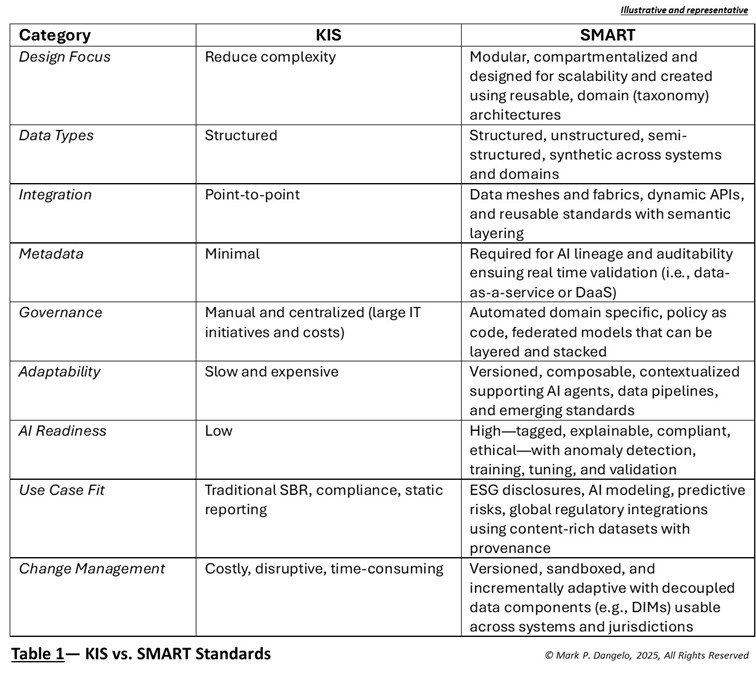
It’s important to note that a decade ago KIS was the primary guiding philosophy used for early standard business reporting (SBR) guidance. However, with AI functionality and the vast data used within these iterating, self-learning, and intelligent systems, regulatory requirements are no longer siloed nor singularly about structured data content or context.
Moving forward, SMART data standards and designs provide the checks and balances for AI solutions — cross-border demands, digital regulatory frameworks, digital regulatory twins, tax & risk reporting, and model training and adaptability. KIS represented the minimal viable product for structured systems and compliance demands. Modern regulatory requirements demand SMART standards and architectures that provide AI-native capabilities.
AI is the engine, but data and standards are the fuel
AI represents the future of industry data-driven solutions, but each implementation cannot be standalone data islands — or with different definitions, characteristics, and context — creating a veritable data Tower of Babel. This is why SMART standards and design approaches are so critical to the embryonic expansion that is AI today.
What should be done to implement SMART data frameworks and standards? The table below highlights five representative call-to-actions (CTAs) that demand robust, modern AI-complaint data standards.
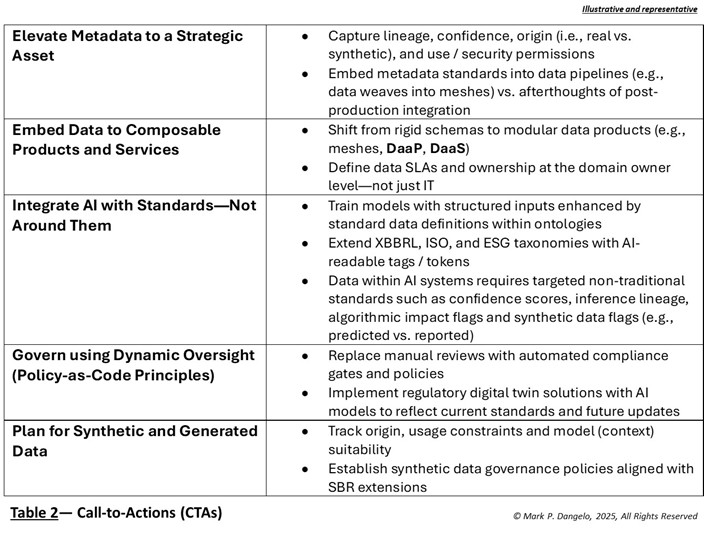
These CTAs show that data standards in an Age of AI represent the on-boarding layer for data ingestion and manipulation to ensure relevancy across operational, decision-support, and reporting systems. AI thrives with the segmentation and inclusion of semantic data standards and models to provide accuracy and fine-tuning as well as auditability and trust.
Putting the SMART data pieces together
KIS data standardization was a mandate designed for prior technological and data ecosystems. They were designed to be passive and used for historical analysis. SMART data standardization with AI addresses the prior business and governmental requirements, but it also aids firms that adopt them by offering problem solving, interoperability, transparency, adaptability, and reusability. The SMART value proposition is one that addresses data multimodality, trust, and of course, accuracy and consistency.
Data standards for AI today when using KIS data frameworks increase costs, governmental burdens, and system complexity at a time when economic uncertainty is increasingly opaque and opposition to more regulation including standards is actively resisted. SMART AI data standards when combined with SBR, on the other hand, changes organizational discussions, priorities, and operating budgets.
As we know, AI is data-driven with federated, compartmentalized capabilities that require consistency, interoperability, and contextualization. AI benefits immensely from SMART data standards and holds significant strategic value across all aforementioned data types. Standards do not disappear in the AI era — they evolved and became business multipliers within and across domain ontologies.
KIS versus SMART AI data standardization can be summarized by an analogy. If AI represented an airplane, and KIS represented an autonomous vehicle, would you drive your airplane on the roads or accept a different navigation approach? Operating tomorrow’s compliance AI systems on yesterday’s roads is not just inefficient — it’s reckless.
Register now for The Emerging Technology and Generative AI Forum, a cutting-edge conference that will explore the latest advancements in GenAI and their potential to revolutionize legal and tax practices