
To maximize AI's value, organizations must strategically link its adoption to clear communication, individual accountability, and human oversight, rather than solely focusing on the technology
Key highlights:
-
-
-
AI strategy should drive individual accountability — Alignment between organizational AI strategy and individual accountability is essential. Most professionals lack clarity on their organization’s AI goals, which hinders meaningful progress and innovation.
-
Strategic AI plan also should drive business revenue growth — Organizations with well-communicated and strategic AI plans are significantly more likely to realize critical business benefits and revenue growth from their AI investments.
-
Personal AI goals boost usage and accountability — Setting and linking personal AI goals for all professionals drives regular use and accountability, which is crucial for turning technology investments into tangible organizational success.
-
-
Organizations are discovering that true AI transformation in this digital age extends beyond technology alone. The key to maximizing AI’s value lies in connecting organizational strategy with individual employee accountability and responsible use, according to the Thomson Reuters 2025 Future of Professionals report. Indeed, the report reveals that without clear communication of AI strategy and the setting of personal AI goals, even the best technology investments can fall short. Only by focusing on their professionals can organizations find their way forward to maximizing the value of their AI investments.
Clearly communicate organization’s AI strategy and goals
A critical yet often overlooked factor in successful AI adoption is the alignment between individual actions and the broader organizational AI strategy. In fact, almost two-thirds (65%) of professionals surveyed who said they have personal goals for AI adoption also said they are not aware of their organization’s overall AI strategy, according to the Future of Professionals report. Further, only 39% of all professionals say they have personal goals linked to AI adoption, which leaves a majority (61%) without clear direction or accountability in their own use of AI.
When professionals operate without clarity on the organization’s strategic direction, their efforts may not contribute meaningfully to broader business objectives. This leads to wasted investment, fragmented progress, and missed opportunities for cross-functional innovation.
The consequences of this misalignment are significant, especially as AI becomes increasingly central to operational efficiency and competitive advantage. The report cites that organizations that craft a strategic plan for their AI adoption and implementation are 3.5-times as likely to see critical AI benefits compared to those without any significant plans. Adding to this, those organizations with a strategic AI plan are almost twice (1.9-times) as likely to already be experiencing revenue growth as a result of their AI investment, compared to those organizations that are adopting AI informally.
These findings underscore that the mere presence of AI technology is not enough. Successful deployment depends on coordinated, intentional actions at every level. For organizations seeking to maximize the value of their AI investments, ensuring that every employee understands how their own learning, experimentation, and adoption of AI tools fits into that vision is just as important as articulating the organization’s overall vision.
Leverage professionals’ personal AI use to drive accountability
Unfortunately, there is a strong disconnect with professionals’ own AI use in the workplace, according to the Future of Professionals report, which reveals that 70% of professionals say they are not yet using AI tools on a regular basis. This gap between organizational ambition and day-to-day practice leads to a situation in which substantial investments in technology yield only limited returns.
Our research makes it clear that regular engagement with AI tools has a significant impact. Professionals who use AI routinely are 2.4-times as likely to report organizational benefits from AI adoption compared to those who use it sporadically or not at all. Yet, setting and linking personal AI goals for every professional remains a rare practice. Only 21% of professionals with AI adoption goals report using AI at least once a week, underscoring the importance of personal accountability in driving meaningful adoption. Additionally, professionals who say they have clearly defined AI goals are 1.8-times as likely to see tangible organizational benefits, highlighting the powerful link between individual commitment and collective success.
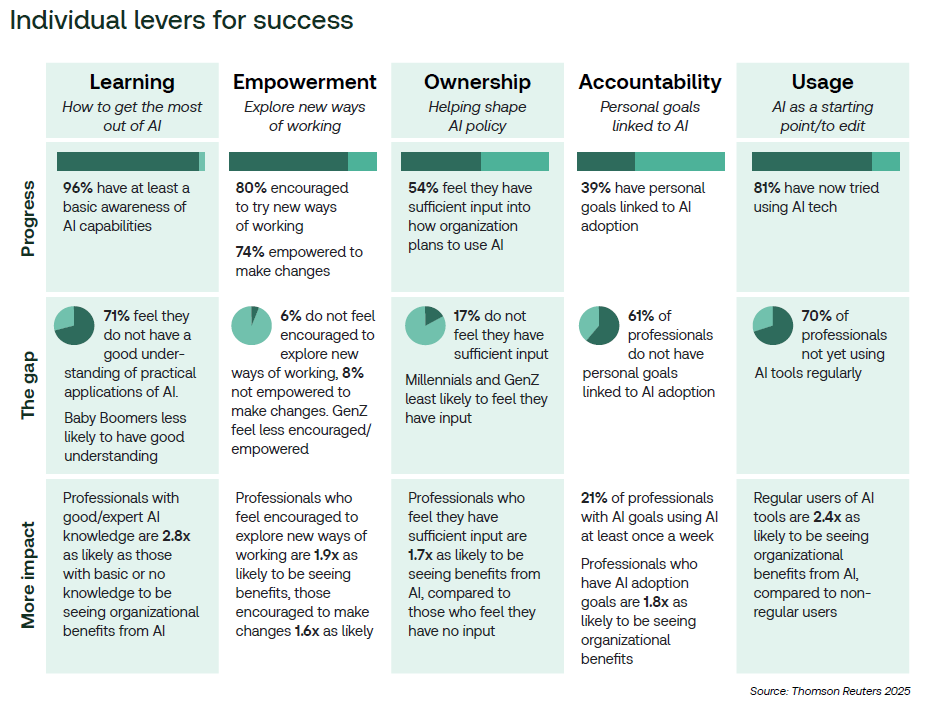
To bridge this gap, organizations must move beyond simply providing access to AI tools and instead require all professionals to set personal AI learning and usage goals that are explicitly tied to broader business objectives.
Mandate human oversight
As organizations accelerate their adoption of AI, they need to require human oversight and responsible use of these technologies. The report notes that concerns about accuracy, security, and the potential for overreliance on AI remain significant barriers to robust adoption. Notably, an overwhelming 91% of professionals say they believe that computers should be held to higher standards of accuracy than humans, with 41% insisting that AI outputs must be 100% accurate before they can be used without human review. This high threshold underscores the persistent trust gap and the need for rigorous validation processes.
Beyond accuracy, professionals are also wary of the impact that excessive reliance on technology could have on their own or their colleagues’ development. Nearly a quarter (24%) of respondents say they fear that overreliance on AI may stunt the growth of essential professional skills. Without ongoing human involvement, there is a real risk that core competencies could erode over time, potentially leaving professionals less capable and more dependent on technology.
The solution lies in fostering a culture of responsible AI use, one in which human expertise remains central. Organizations must therefore set clear standards for AI oversight, provide training on ethical and critical evaluation of AI outputs, and encourage continuous skill development alongside technological advancement.
As organizations chart their course through the rapidly evolving landscape of AI, the most successful will be those that put their people at the heart of their strategy. By acting intentionally and fostering a culture in which human insight and innovation drive the use of AI, both organizations and individuals can secure lasting success and lead the way into an AI-enabled future.
You can download a full copy of the 2025 Future of Professionals report here