
Many organizations are jumping into GenAI without being able to measure its impact; however, according to the recent “Future of Professionals” report, ROI can be found — and it starts with mapping to broader measurements of success
Key takeaways:
-
-
-
Strategic alignment drives ROI — Organizations that implement GenAI with a clear, formal strategy aligned to their broader business goals, such as revenue growth or client experience, are able to find stronger ROI measurements than those adopting AI informally.
-
Measuring GenAI requires more than basic metrics — While many firms currently track simple, internally-focused metrics like cost savings and user adoption, true value from GenAI comes from mapping its use to strategic outcomes such as revenue generation, operational efficiency, and client satisfaction.
-
AI strategy aids measurement capabilities — Despite increasing adoption of GenAI tools, less than one-quarter of professional services organizations have a visible AI strategy, according to our research, which decreases their ability to properly measure GenAI’s organizational impact.
-
-
At this point of the lifecycle of generative AI (GenAI), most individuals across the professional services world have a conception of what GenAI is and what it can do. Indeed, 96% of respondents had at least a basic understanding of AI principles, according to the 2025 Future of Professionals report, which surveyed corporate, legal, tax & accounting, and government professionals.
With that in mind, most organizations are prepared to take the next step: Making GenAI an integral part of their operations and measuring its direct impact on the organization. It’s a natural progression, as individual use of publicly available GenAI technologies such as ChatGPT or Claude turns into institutional investment in business-centric tools such as Microsoft Copilot or industry-specific GenAI tools.
Of course, organizational leaders whose teams are using these tools want to see how much these tools really help, and attempt to quantify GenAI’s return-on-investment (ROI).
However, those that have undertaken the ROI exercise have found that arriving at an answer may be easier said than done for a number of reasons. Many professionals are just beginning with the tools and have not yet fully integrating them into their workflow, which makes the true impact of GenAI harder to measure. Determining the time saved by AI tools requires an intricate knowledge of how these professionals work on a daily basis; and most professional services firms are not yet talking to their outside clients about GenAI, making calculations around business won or client satisfaction next to impossible to compute.
That said, however, there already are some simple ways to start to map GenAI usage to a set of ROI metrics. It starts with knowing what your organization wants to achieve by using GenAI.
Mapping use cases to goals
GenAI, as is the case with all business-oriented technologies, should not be treated as a goal in itself. When determining metrics around AI use, start with the organization’s primary set of strategic initiatives then extrapolate from there.
For instance, increasing revenue is a way 81% of C-Suite respondents say they measure success, according to the Thomson Reuters Institute’s recent 2025 C-Suite Survey. GenAI, therefore, should be rolled out with this in mind, with potential use cases for the technology aimed squarely at increasing revenue such as by delivering stronger market analysis and predictive analytics for client issues. If instituted with the larger revenue goal in mind, the ultimate metric for the technology’s success then is not simply usage, but how well the technology actually contributes to revenue gains.
The chart below from the Future of Professionals Report provides some examples from a law firm perspective of how other organizational goals can lead to ROI metrics, including bolstering the client experience, creating operational efficiencies, and attracting and engaging talent. Other industries such as tax, audit & accounting; government agencies; and courts have their own sets of goals that can be adapted in the same fashion.
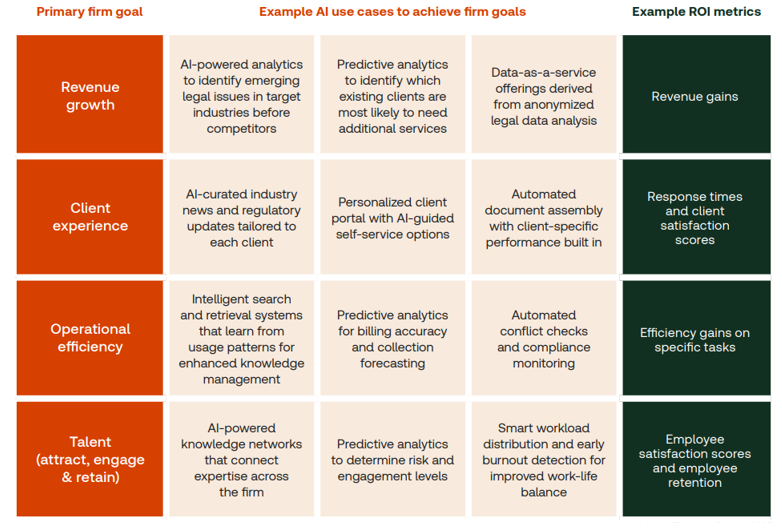
GenAI is a powerful tool particularly because of its versatility. While many past technologies aimed at professional services were focused squarely on one or two use cases, GenAI, as demonstrated above, can be adapted to serve a number of different uses and goals. As a result, implementing these use cases — and crucially, measuring their success — requires more strategic planning than past technologies.
The importance of strategy
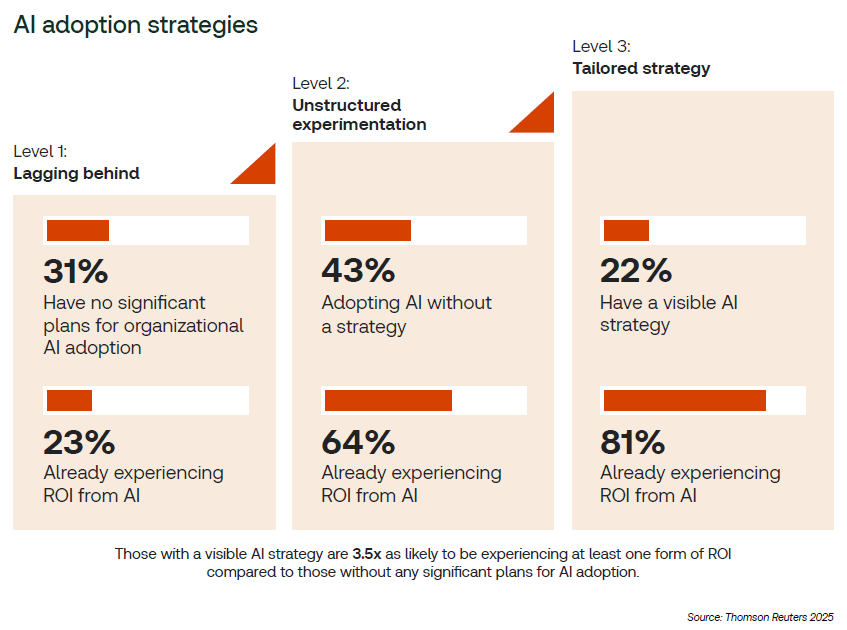
Even with the rate of GenAI adoption continuing to climb, formal AI strategies are not climbing at the same rate. The Future of Professionals report found that just 22% of respondents say their organizations have a visible AI strategy, while 43% say their organizations are moving ahead with adoption despite having no formal strategy in place. About one-third of respondents, meanwhile, say their organizations have no significant plans for widespread adoption.
Unsurprisingly given the above, this lack of strategy has a tangible impact on measurable ROI, particularly as it relates to underlying revenue. The report notes that organizations with a strategic AI plan are almost twice (1.9-times) as likely to already be experiencing revenue growth as a result of their AI investment than those organizations that are adopting AI informally. Similarly, 81% of respondents at organizations with an AI strategy report seeing some sort of positive ROI from AI; only 64% of respondents at organizations adopting AI informally say the same.
Measuring proper ROI from GenAI implementation is not an impossible undertaking, but at the same time, it is not an easy proposition. The Thomson Reuters Institute’s 2025 Generative AI in Professional Services Report from earlier this year found that even of those organizations measuring GenAI’s impact, the most common metrics were simple and often internally-focused, such as internal cost savings, user adoption, and user satisfaction. Metrics focused on client satisfaction or external revenue generation, meanwhile, were tracked by less than 40% of organizations, according to survey respondents.
That is the wrong way to approach AI measurement, particularly in a professional services landscape that expects GenAI (and soon, agentic AI) to become a central part of the profession’s workflow within the next five years. If GenAI is becoming so crucial to the organization, then its measurement should be based not on simple technology metrics, but on larger strategic metrics for the organization.
And that means, for organizations without an AI strategy that links to the larger organization’s overall strategy, the time to begin that planning in earnest for the AI-driven future has arrived.
You can download your copy of the 2025 Future of Professionals Report here