Ask any professional today whether they use AI, and the answer is almost certainly yes. Ask their organization whether that AI strategy is working, and the answer gets a lot more complicated.
That’s the tension at the heart of our fourth annual Future of Professionals Report. We surveyed 1,816 professionals across law, tax, audit, accounting, compliance, and global trade in 62 countries, and the story that emerged isn’t really about AI adoption anymore. It’s about what happens when adoption races ahead of everything an organization needs to change around it.
As Thomson Reuters President and CEO Steve Hasker writes in the report’s foreword,
“The AI tools are ready, but growing adoption has not yet been matched by internal transformation, and the business process redesign required to capture positive return on AI investments.”
Read that twice, because it’s the sentence that explains almost everything else in this year’s findings.
Everyone’s using it. Not everyone has what they need.
Here’s what makes this moment strange: 74% of professionals now use AI several times a week, and nearly half turn to it multiple times a day. By any normal measure, that’s a technology success story.
But look closer and the picture shifts. 41% of professionals who use AI at work still don’t have access to tools built for the standards their profession actually demands, tools that protect confidential data, ground their answers in authoritative content, and show their reasoning clearly enough to defend it. So people do what motivated professionals always do when the tools they’re given fall short: they find their own. More than a third now use AI their organization hasn’t approved or can’t see, quietly building risk no one is tracking.
Clients feel this gap too. Nearly 78% corporate buyers of professional services say AI-enabled quality improvements matter enormously to them. Just 6% say they’re getting that from most of the firms they hire. Almost a third are already reconsidering those relationships, and among the ones walking, a third estimate more than $1 million in annual work is on the line.
Talent is walking too, for the same reason. 91% of professionals feel some degree of AI value gap between what they expect AI to deliver and what they’re actually getting at work. One in four of them is already planning to leave within two years, and replacing them costs an estimated $232,000 each. The people driving the most change in how their work gets done, the changemakers inside every firm and department, are also the ones with the most options elsewhere.
Three futures, and every organization is already choosing one
Here’s the part of the report we find most useful for leaders: whether your organization has thought about it deliberately or not, you’re already answering one question through your actions: what is AI really for?
The data shows three distinct answers taking shape:
Some organizations are choosing AI to Elevate, putting human expertise at the center and using AI to clear away routine work so people can spend more time on judgment, strategy, and relationships. It’s the answer most professionals want for themselves, chosen by 52% as their preferred future.
Others are pursuing AI to Scale, treating AI mainly as a capacity solution: more volume, faster turnaround, steadier quality, without growing headcount at the same rate. Roughly a third of professionals see this as their path.
A smaller group is going further still with AI to Reimagine, rebuilding how they operate and what they offer clients around capabilities that didn’t exist before, rather than optimizing what’s already there. Only 7% describe this as their current reality, but they’re also the most ambitious professionals in the survey, and the least patient with organizations still moving at the old pace.
None of these paths is wrong. What the data does make clear is that choosing one on purpose, and following through, beats drifting into one by accident. Where organizations have named an AI strategy, 66% of professionals say AI is meeting or beating expectations for creating value. Where there’s no active strategy at all, that number drops to 22%.
Why the strategy on paper never seems to reach the desk
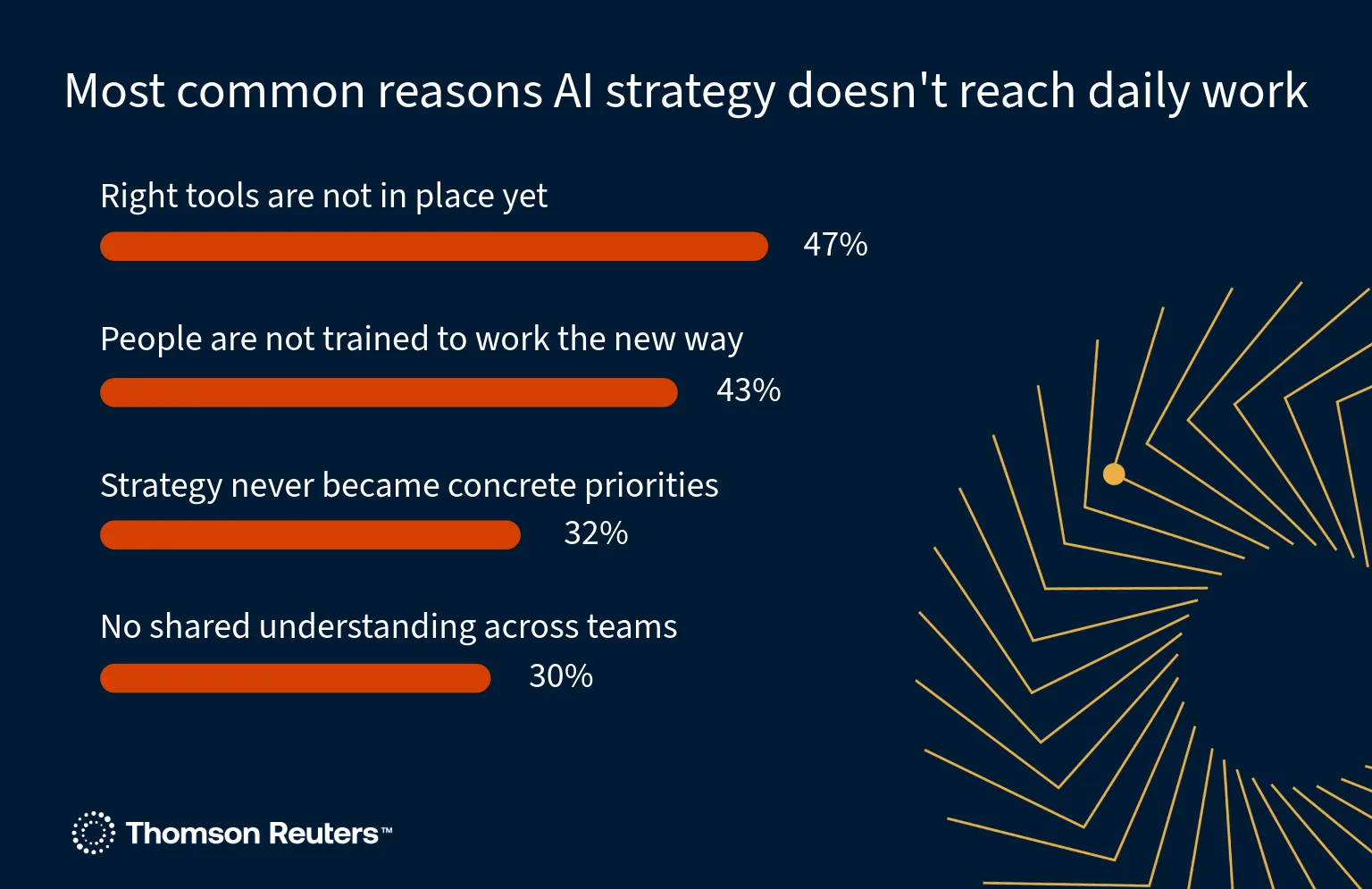
This is where so many organizations lose the thread. 35% of professionals whose organization has a named AI strategy say they don’t truly see it in their day-to-day work. The strategy exists. It just hasn’t traveled.
Professionals point to the same handful of reasons, again and again. Nearly half say the right tools simply aren’t in place yet. 43% say they were never trained to work the way the strategy assumes, no one taught them when to trust AI’s output, when to double-check it, and when to override it entirely. 32% say the strategy never got translated into anything concrete enough to act on. And nearly a third say there’s no shared understanding of the plan across the organization at all, different teams are quietly working from different assumptions about where things are headed.
The choice in front of every professional
What comes through most clearly across all 1,816 responses is that this moment rewards the organizations willing to choose deliberately and build toward that choice with discipline, rather than wait for the perfect strategy to arrive fully formed. As Hasker puts it, “AI is a powerful force multiplier, but the judgment, relationships and accountability remain human, and that won’t change.”
That’s the real dividing line in this year’s data, not who has access to AI, but who decides on purpose what to do with it. The professionals and organizations pulling ahead aren’t waiting for someone else to hand them a strategy. They’re changemakers, whether or not they’d use the word, and they’re exactly who we build for.
Read the full Future of Professionals Report to see where your organization stands, and where your biggest opportunity is hiding.