
As corporate legal departments rush to adopt AI, a new report shows that many existing legal tech tools are underutilized, which means that departments are not even taking full advantage of the technologies they’re already deployed
Key insights:
-
-
-
More focus on implementation, training, and integration is needed — Many legal departments need to be more prepared before accelerating their AI adoption plans.
-
Legal departments are looking to AI-driven tech tools to help them improve efficiency and reduce costs — Most corporate legal professionals say they consider their departments under-resourced but feel that technology can make processes more efficient.
-
Use of legal technology is expected to increase — Many legal departments report increasing or stable budgets for technology investments.
-
-
Corporate legal departments are racing to add new technologies. The rapid advancement of AI not only means that promising new solutions are emerging just about every day, but also that organizations and their legal departments may feel compelled to engage in a technology arms race in order to keep up with competitors.
There are vital lessons and warnings that legal departments should heed, however, as they rush to adopt AI and other emerging technologies.
The race is on
The emergence of AI-driven tools comes as legal departments stand at an important crossroads. They are under increasing pressure to take on more tasks while controlling costs. Indeed, more than half of the in-house legal professionals surveyed say their legal departments are under-resourced, according to the 2025 Legal Department Operations (LDO) Index, published by the Thomson Reuters Institute (TRI) in conjunction with Buying Legal Council.
At the same time, however, survey respondents ranked greater use of technology as one of the top ways to improve efficiency and reduce costs. It’s not surprising then, to find that 59% of respondents say they are increasing their use of technology tools, and an overwhelming 88% say they have stable or increasing tech budgets to make that happen.
You can check out our 2025 LDO Index Infographic here
As a result, the number of legal departments that are looking to implement fast, large-scale technology deployments is surging. Although it’s currently only 12%, that’s a four-fold increase from just 3% last year, and it’s likely to continue climbing as the race to adopt AI tools intensifies.
Not surprisingly, AI-powered tools are some of the fastest-growing solutions being adopted by legal departments. Yet, adoption does not necessarily mean effectiveness — and as the LDO Index reveals, there are some important warning signs flashing as legal departments rush headlong into the AI future.
Underutilized tech tools
One of the most significant parts of this sobering reality is that many legal departments are not even taking full advantage of the technologies they’re already deployed.
In fact, many technologies are being used widely across legal departments — such as legal research, spend management, and e-discovery — however, for many of these automation tools are underutilized and not being used effectively, despite the fact that the tools are considered valuable when used, according to the report.
That means that many technologies that have proven their worth within a legal department remain largely underutilized, collecting digital dust even though they could help the department achieve greater efficiencies.
Legal department software solutions are underutilized
The reasons for underutilization are many-fold, including inadequate training, lack of awareness, and failure to properly integrate technology solutions.
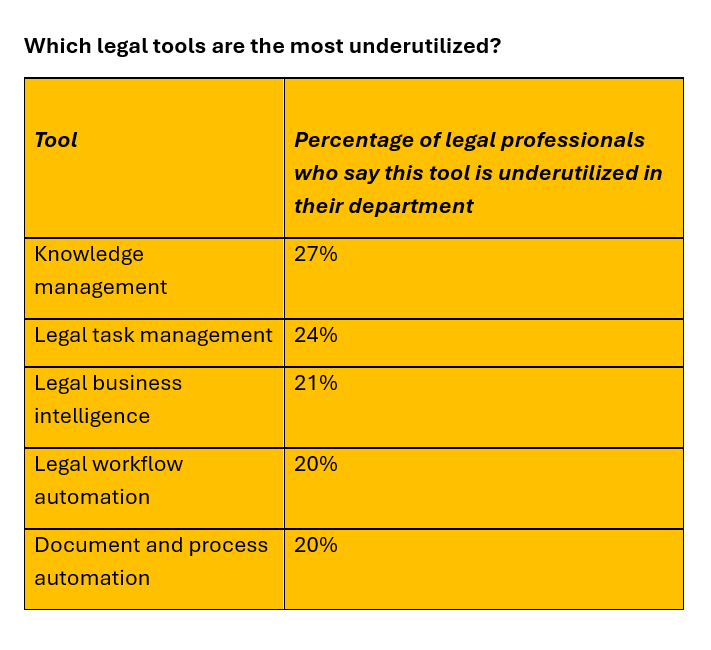
And the early signs for more advanced AI-driven tools is that they are following the same troubling pattern. Contract AI tools are currently more than twice as likely to be considered underutilized than being used effectively. Generative AI (GenAI) tools also are struggling to achieve an even split between underutilization and effective usage.
The underutilization of existing technology in legal departments isn’t just a current operational challenge — it’s a warning signal about departments’ readiness for the AI era.
The good news, however, is that AI tools are still in the relatively early stages of adoption. Legal departments are more likely to report that they have not yet adopted GenAI tools but are looking to procure them over the next 24 months, so there is still time to prepare. Therein lies the opportunity for legal departments to take steps now to ensure that they have not only chosen the right technologies but are deploying them properly to help ensure effective usage.
Some of these steps toward proper preparation include:
Conducting a technology audit — Assess the current utilization of existing legal tech solutions and use this assessment to prioritize investment towards those tools that address the department’s most pressing needs. This will enable strategic investments in the specific technologies that are most likely to drive efficiency and value.
Ensuring the department is ready — Deploying new technologies requires resources, and department leaders need to make sure there is sufficient implementation bandwidth.
Understanding that AI implementation is different — Unlike other technologies, AI is likely to require new processes, policies, and governance frameworks in order to be most impactful. In addition, AI adoption will require more substantial changes to departmental workflows, role definitions, and work practices than previous technology deployments.
Providing effective training and education — Attorneys and staff need to feel confident they know how to use a tool to get the most out of it and additional training on these tools can provide that. And by sharing use cases and best practices, leaders can reinforce training and continually drive awareness.
As the LDO Index report shows, successful technology adoption requires careful planning and execution. Corporate legal departments can’t simply purchase AI tools and expect them to magically generate efficiency from day one.
However, with proper planning and change management, new advanced technologies and AI-driven tools can transform legal department operations. By following the outlined steps to ensure better preparedness, leaders can help their legal departments prevent their AI investments from turning into expensive technology budget line items that ultimately disappoint by failing to deliver promised efficiency gains.
You can download a full copy of the 2025 Legal Department Operations Index here