
The 2026 FIFA World Cup poses an unprecedented human trafficking risk across North America due to its extraordinary scale, duration, and geographic spread — institutions must take proactive, coordinated action now to protect vulnerable individuals
Key highlights:
-
-
-
The scale of risk demands urgent attention — The World Cup’s five-week span across three nations creates a human trafficking risk profile far beyond any previous North American sporting event.
-
Geographic exposure extends far beyond host cities — Unlike the Super Bowl, where risk is concentrated in one metro area, the World Cup’s national identity-driven fan engagement means every city in the US, Canada, and Mexico is effectively a participant city.
-
Cross-sector preparation is the most critical investment — Cutting down siloed operations among law enforcement, financial institutions, and NGOs is required, that means establishing financial institution task forces, training frontline bank branch employees to recognize trafficking indicators, sharing cross-sector information, and amplifying public awareness campaigns before the tournament begins is crucial.
-
-
The 2026 FIFA World Cup will be the largest sporting event ever hosted on North American soil, a tournament with 104 matches spanning more than five weeks across three nations and drawing an estimated 6.5 million visitors from around the world. While the United States hosts large sporting events like the Super Bowl each year, the World Cup brings with it the unique challenges of length of time, fan influx from around the globe, and geographic expansion.
Assessing the scale of human trafficking risk
To understand the magnitude of the human trafficking risk involved in events such as this, it is useful to apply a framework that accounts for three variables: i) the likelihood of a trafficking event; ii) the potential extent of damage; and iii) the duration of exposure. When that framework is applied to the 2026 World Cup, the human trafficking risk associated with the event registers high due to numerous factors.
For more on this, tune into the Thomson Reuters Institute’s latest “Clarity” podcast to learn about the anti-money laundering challenges posed by the World Cup
The most significant differentiating factor of the World Cup is its time duration. The Super Bowl is a single-day event, and the Olympics run approximately two weeks. The 2026 World Cup spans more than five weeks across three nations, a duration that has no modern sporting equivalent. The last three World Cups, held in Brazil, Russia, and Qatar, offer limited comparative value given the substantial differences in legal frameworks, cultural contexts, and infrastructure. For purposes of risk assessment, this is why the Super Bowl represents the most relevant domestic benchmark, even though it falls considerably short as a true comparison.
Human trafficking evidence from the most recent Super Bowl
The most recent Super Bowl, held in the San Francisco Bay Area in February 2026, illustrates the scale of the human trafficking challenge. A coordinated anti-trafficking campaign conducted across 11 Bay Area counties resulted in the recovery of 73 sex trafficking victims, including 10 minors, and 29 arrests, all in connection with a single-day event.
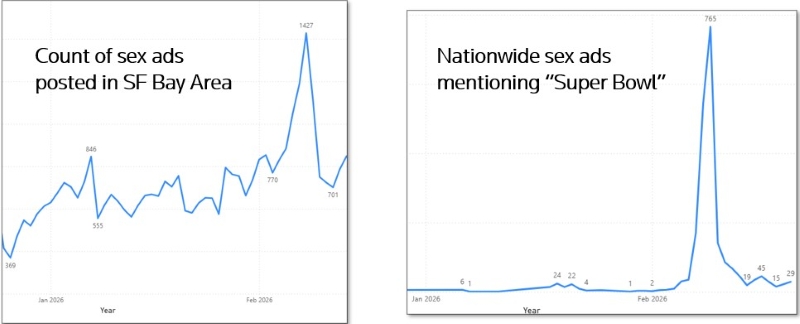
Sex advertisement data from that period further substantiates the scale of human trafficking concern. In the months preceding the event, advertisement volume rose steadily before spiking dramatically during Super Bowl weekend and declining sharply in the days that followed. Analysis that was restricted to advertisements referencing the Super Bowl by name showed trend lines that remained essentially flat until the event itself, at which point volume surged significantly.
Likewise, examination of phone numbers associated with those advertisements revealed organized and purposeful movement. Nearly 500 unique numbers that had posted sex advertisements in other states in the preceding weeks appeared in San Francisco during the event.
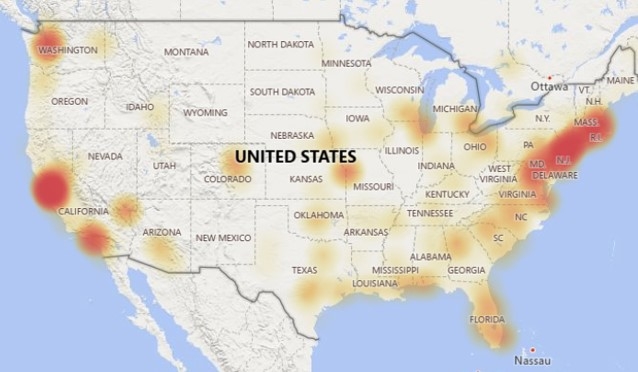
The risk of human trafficking expanding beyond the host city is one additional insight uncovered during the anti-trafficking operation during the Super Bowl. Advertisements referencing the Super Bowl spiked simultaneously in Boston and Seattle, the home cities of the two competing teams. In the context of the World Cup, every city in the United States, Mexico, and Canada is effectively a participant city, and national identity rather than team affiliation drives fan engagement. The geographic distribution of risk is therefore exponentially greater than anything observed around the Super Bowl.
Hotspots of sex ads
What anti-trafficking partners should do now
Those organizations and institutions that take action in advance of the World Cup will be substantially better positioned to detect exploitation and protect vulnerable individuals. More specifically, these organizations should:
- Establish financial institution task forces in advance of the event — Convening local financial institutions to align on existing practices and identify gaps will aid in ensuring all parties are on the same page. It also establishes relationships and procedures that cannot be built effectively during a five-to-six-week surge in cross-border transactions. Activating established information-sharing mechanisms, such as the processes supporting the filing of suspicious activity reports (SARs) in the US and the suspicious transactions reports processes in Canada, will be essential for detection and pattern recognition.
- Institute branch-level employee training at local financial institutions — Frontline employees possess local knowledge that no centralized system can replicate. A branch employee in a high-traffic urban location understands the patterns of their customer base and is often the first to recognize when something is amiss. What they frequently lack is the context in which to interpret that instinct and the guidance to act upon it. Addressing that training gap before the World Cup represents one of the highest-value preparedness investments available to financial institutions at this time.
- Dismantle institutional silos — Siloed operations, in which law enforcement, financial institutions, and non-governmental organizations (NGOs) each operate independently, represent the least effective organizational posture for an event of this scale. Institutions that establish cross-sector relationships and information-sharing commitments in advance will be meaningfully better equipped to respond.
- Develop and amplify public awareness campaigns — Research demonstrates that sustained public awareness campaigns and visible law enforcement presence reduce demand. Host cities, law enforcement agencies, and NGOs should treat this as actionable guidance in planning their response strategies.
The 2026 FIFA World Cup is not simply another major sporting event. The institutions, agencies, and organizations that approach it as such will find themselves unprepared for a scale of human trafficking risk that North America has never previously encountered.
You can find more about the resources, tools, and information that cities and organizations need to address human trafficking around large-scale sporting events at the Thomson Reuters Institute’s Large-Scale Public Events Toolkit here