
As law firms face significant challenges from evolving client expectations — especially around AI, pricing, and relationship depth — they need to pursue greater transparency, innovation, and differentiation to maintain growth and client trust
Key insights:
-
-
-
Despite a strong 2025, law firms face growing challenges — Client expectations continue to evolve, as more clients are now more sophisticated around AI and pricing, pushing law firms to provide greater transparency and communication.
-
Client relationships are becoming shallower — As clients increasingly demand transparency and collaboration, particularly regarding AI adoption and pricing models, law firms must adapt quickly to meet these new expectations.
-
Differentiation is more vital than ever — Responsiveness, speed, and clear communication about value and technology have emerged as key factors for law firms to stand out and deepen client relationships.
-
-
AMELIA ISLAND, Fla. — It may have already become cliché to say that the legal industry is at a significant crossroads: Firms are coming off what appears by all measures to be a very successful 2025, yet the industry also is facing fundamental structural change, driven mainly by AI and subsequent changing client expectations.
Subsequently, that temperament permeated the opening sessions of the Thomson Reuters Institute’s 33rd Annual Chief Marketing & Business Development Officer Forum (formerly the Marketing Partner Forum) held this week.
“No matter how well we’re all doing, the angst level has never been higher,” said one law firm leader at the Forum.
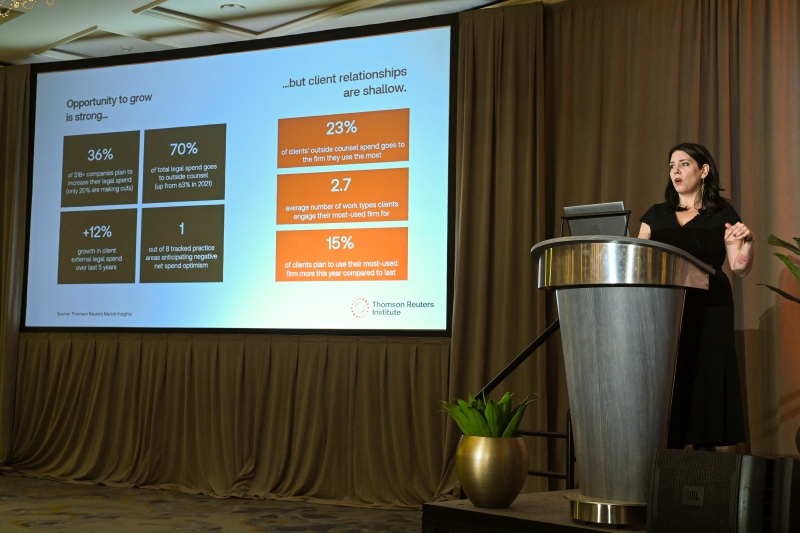
Jen Dezso, Director of Client Relations at the Thomson Reuters Institute, opened the event giving a data-rich thumbnail of the legal market, based mostly on the recently released 2026 Report on the State of the US Legal Market, published jointly by the Thomson Reuters® Institute and the Center on Ethics and the Legal Profession at Georgetown Law. Dezso demonstrated that almost all key indicators for law firm performance are up — demand, fees worked, lawyer growth — and that firms seem to be “monetizing the work they capture.” The main drivers pushing firm growth, she explained, are being moved by strategic wins of high-value business rather than a higher volume of ordinary work.
“No matter how well we’re all doing, the angst level has never been higher.”
Yet there are some darker clouds on the horizon, she added, noting that client relationships may be a bit shallow. For example, while just over one-third of large clients (36%) said they plan to increase their legal spend in the coming year, less than one-quarter of that spend (23%) goes to the firm that the client uses most — a figure that has been dropping over the last several years. Indeed, that most-used firm now gets engaged for less than three work types, and only 15% of clients say they will use their most-used firm more in the coming year.
Not surprisingly then, these figures weighed heavily as panels of top lawyers and law firm marketing and business development specialists discussed these matters during the Forum.
“Clearly, the softening of client relationships is a key piece of this,” said one business development officer. “And you can see that in RFPs and the level of transparency that clients are asking for. I think a lot of work needs to be done by law firms to ensure these deeper trusting relationships with clients.”
Others on the panel agreed. “Financially we’re doing very well, but we should be looking at what has changed with the clients,” one said, adding that many outside law firms may not have fully processed the impact the global pandemic has had on client relationships over the ensuing five years.
What’s changed in clients’ minds?
Understanding and adapting to this change in clients’ mindsets should be mission critical for law firms today. Indeed, all other initiatives — collaboration, pricing, business development, and more — will flounder on the rocks if law firms don’t engage with their clients directly. And the primary result of that engagement should have law firms coming away with an understanding of what clients want and need and, even more importantly, where clients see their outside firms failing to meet those needs.
Though obviously a difficult conversation, this level of client engagement is the only way firms are going to be able to deliver for clients while remaining sustainable, innovative, and profitable themselves.
You can read the full Executive Summary of the Thomson Reuters Institute’s 33rd Annual Chief Marketing & Business Development Officer Forum here
Perhaps the most dramatic shift these panelists perceive is the change in client expectations around AI. Several noted that there is a growing disconnect between what clients believe AI should enable law firms to do and what firms are actually delivering — and many said this was the fault of poor communication. For example, RFPs now routinely include references to AI, with clients moving from a stance of caution — You can use AI, but not with my data — to one of collaboration — Where can we work together within the AI space? This rapid evolution requires firms to be able to communicate their clear roadmap for AI adoption and pricing innovation that is understood by partners and can be conveyed easily to clients.
“Transparency and communication are paramount,” offered one law firm executive. “Firms must be able to explain their approach to AI and demonstrate its value to clients.” In fact, several panelists suggested that the best opportunities to deepen client relationships often arise in these conversations around technology and innovation.
In many cases it is the role of the Chief Marketing and Business Development Officers to lead these conversations, especially as these talks can help differentiate the firm. “The leaders in these roles may have the most important job within their firm,” noted one panelist. “The capability of these roles to see outside the walls of the firm is incredibly important.”
Several panelists pointed out that increasingly in today’s crowded marketplace, differentiation is more vital than ever, yet seemingly more difficult to achieve. “Sometimes it does come down to responsiveness and speed — these age-old client service tenants that we’ve all pursued forever,” said another firm marketing professional.
In fact, according to Thomson Reuters Institute data, clients look at several areas of differentiation when considering outside legal services, including the firm’s AI implementation, with 40% of clients citing that. And while clients ranked both cost efficiency and the use of value-based pricing lower, at 29% and 16% respectively, many law firm leaders said they consider pricing a critical challenge for the industry, especially given the mounting pressure on the traditional billable hour model.
“We need to get clients to look at value, and we need to get our own partners to look at our own value proposition,” explained one firm leader. “If we can’t segment the work and see what it takes to deliver this, we are in trouble.”
As the Forum discussions illustrated, as clients become much more sophisticated around pricing, law firms have to make sure their lawyers and partners can communicate the firm’s value to clients. “We, as law firm leaders, need to have confidence in what are partners are saying — I mean, that’s true marketing — and we need to talk through these issues with partners, so everyone is more comfortable addressing this with clients.”
You can find out more about next year’s Chief Marketing & Business Development Officer Forum 2027 here