
In a rapidly changing legal market, law firms that align their culture, strategy, and compensation are better positioned to attract and retain top talent, reduce attrition, and drive long-term performance
Key insights:
-
-
-
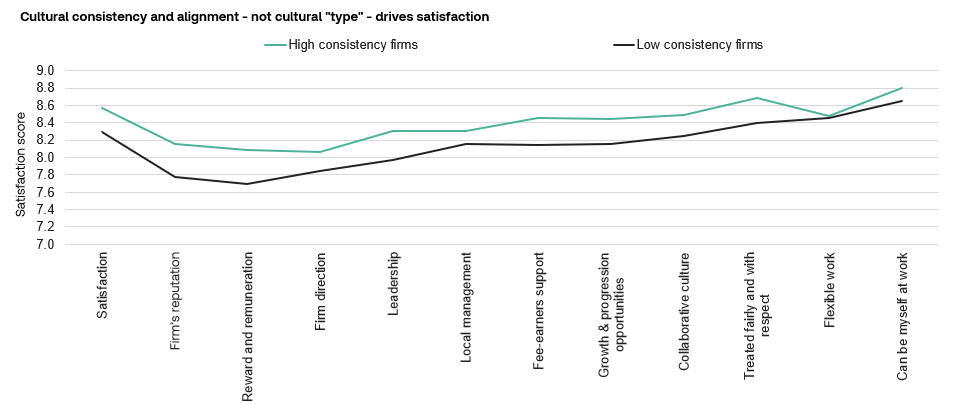
Seeking cultural clarity — The satisfaction of lawyers in a firm is not dependent on whether the firm is traditional or innovative, but rather on the clarity and consistency of the firm’s culture across the organization.
-
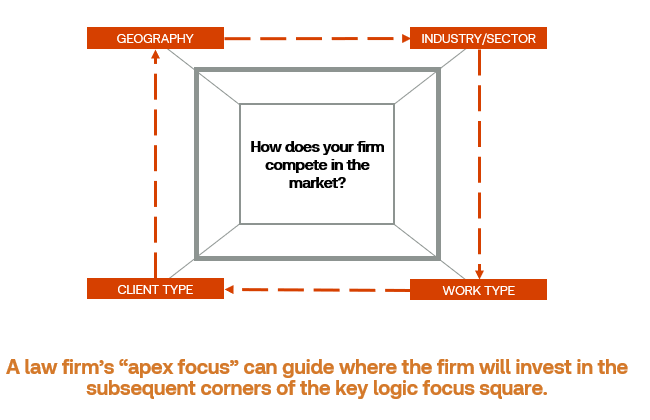
Achieving strategic alignment — A firm’s strategy is only effective if it is clearly understood and embraced by its lawyers. This alignment helps avoid the risk of the firm trying to be everything to everyone and ultimately being known for nothing.
-
Ensuring compensation alignment — Compensation models should align with the firm’s culture and strategy to reinforce desired behaviors. Misalignment can erode trust and engagement, especially in larger law firms.
-
-
In a legal market defined by rapid change and rising expectations, law firms are rethinking what it takes to attract and retain top talent. A new research report from the Thomson Reuters Institute, Law Firm Culture: Keys to Unlocking Firm Growth & Lawyer Engagement, offers a clear takeaway: Law firms that align their culture, strategy, and compensation are better positioned to engage lawyers, reduce attrition, and drive long-term performance.
Culture: Clarity over type
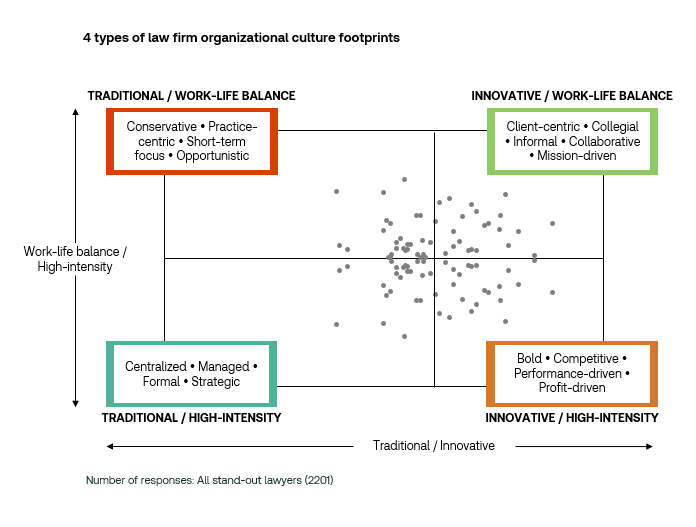
The research shows that lawyer satisfaction doesn’t hinge on whether a firm is traditional or innovative, high-intensity or work-life balanced. Instead, what matters most is cultural clarity — a shared understanding of what the firm stands for and how that shows up in day-to-day decisions.
The report identifies four common cultural footprints, shaped by two key dimensions: work environment and innovation approach:
-
-
- Traditional / Work-Life Balance — Conservative, short-term focused, and opportunistic
- Innovative / Work-Life Balance — Collegial, collaborative, and mission-driven
- Traditional / High-Intensity — Competitive, performance-driven, and profit-focused
- Innovative / High-Intensity — Strategic, formal, and experimental
-
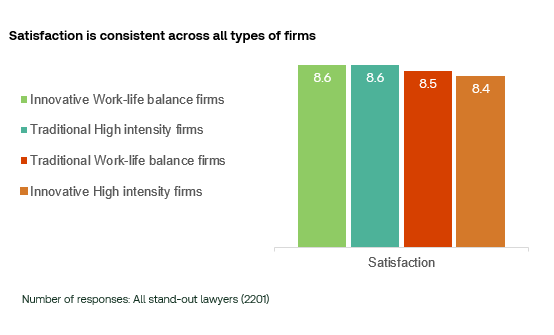
Satisfaction levels are consistent across all four. The differentiator? Whether lawyers experience the culture consistently across the firm.
Law firm leaders must take deliberate steps to understand their firm’s culture and how it might support — or hinder — long-term strategic goals. This effort involves evaluating whether internal values, behaviors, and norms align with the brand the firm aims to project externally. Structured tools, such as cultural mapping and alignment assessments, can help bring clarity to these elements, which often feel intangible but have a direct impact on client experience, talent retention, and market positioning.
Strategy: From vision to execution
A firm’s strategy is only as strong as its ability to execute it, and that execution depends on cultural alignment. When lawyers understand and embrace their firm’s strategic direction, they become its most effective advocates — both internally and in the market.
Without that alignment, firms risk falling into the trap of trying to be everything to everyone — and ultimately being known for nothing in particular.
Defining a clear strategic focus and reinforcing it consistently across the firm is essential to avoiding dilution and driving market differentiation.
Compensation: The reinforcer of culture and strategy
Compensation is more than a financial lever — it’s a signal of what the firm truly values. Yet, 4-in-10 stand-out lawyers say their firm’s compensation model is only moderately aligned or is in fact poorly aligned with the firm’s culture and strategy.
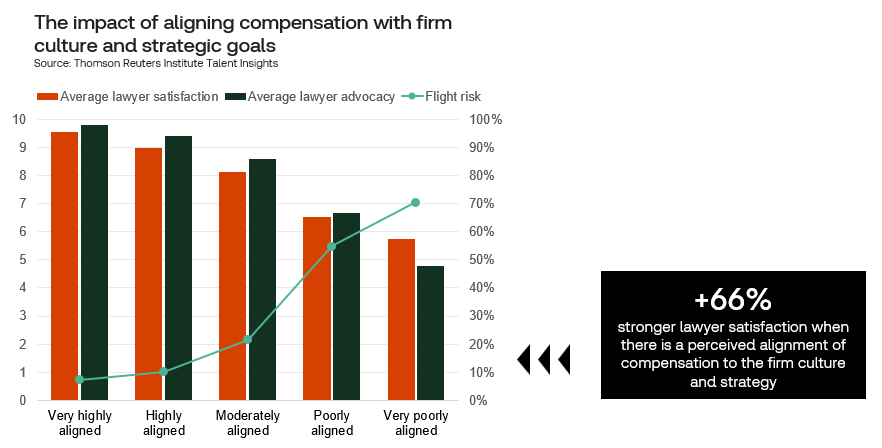
This misalignment can erode trust and engagement, especially in larger firms where complexity increases and consistency becomes harder to maintain. Firms that align all three — culture, strategy, and compensation — see a 66% increase in lawyer satisfaction and a significant drop in flight risk, according to our research.
From insight to action
To move from intention to impact, firm leaders should ask themselves several questions, including:
-
-
- “Are our lawyers aligned on what makes us different?”
- “Is our compensation model reinforcing the behaviors we want to see?”
- “Is our strategy clearly understood and consistently communicated?”
-
These questions aren’t just reflective — they’re foundational to building a law firm in which talent thrives.
The bottom line: Alignment isn’t a nice-to-have — it’s a competitive advantage. Firms that bring culture, strategy, and compensation into sync don’t just retain talent, they unlock its full potential.
You can download the full report, Law Firm Culture: Keys to Unlocking Firm Growth & Lawyer Engagement, from the Thomson Reuters Institute here.