
Despite previous record increases, law firms continue to raise their rates at a historic clip; but, amid fundamental questions about what’s driving rates higher, a new report shows that long-held beliefs about what constitutes better rate performance may be incorrect — and coming exactly at the wrong time
Executive Summary
Key takeaways
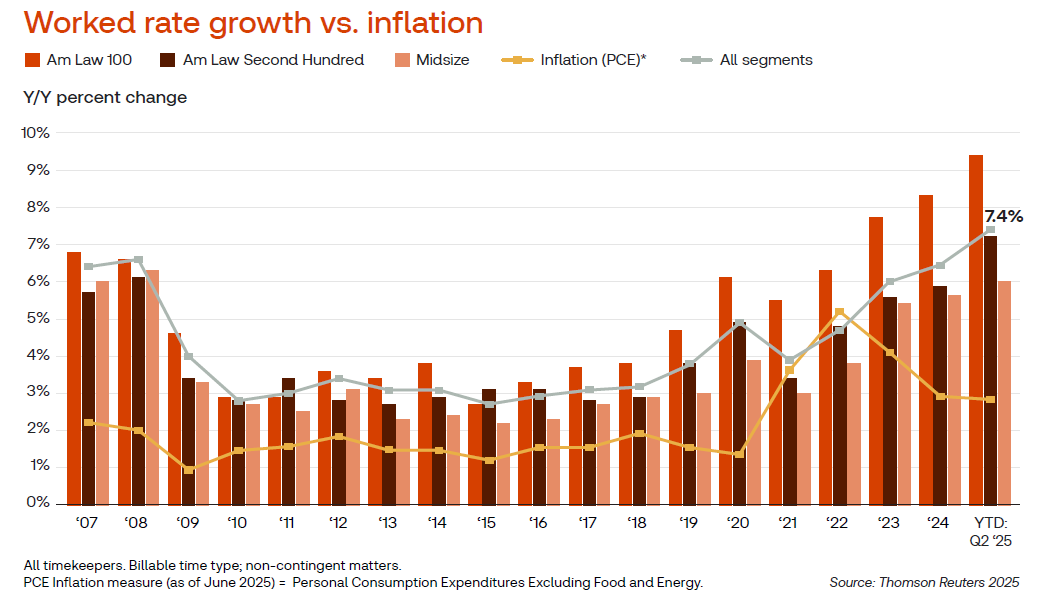
- Law firms continue to benefit from historically high rate increases, well above the rate of inflation, a new report shows.
- While law firms employ a variety of rate and realization strategies, firms across all major configurations consistently collect similar amounts per hour despite employing highly distinctive realization strategies.
- The relationship factors that allow firms to push through significant annual rate increases with existing clients contribute only slightly to competitive differentiation, the report notes.
The legal profession has achieved what most industries can only imagine: The ability to raise prices year after year, with clients consistently agreeing to pay more. Over the past decade, law firms have pushed rates at twice (or more) the rate of inflation, and 2025 is no exception — worked rates are up 7.4% compared to just a 2.8% inflation rate. This isn’t just a routine cost-of-living adjustment, rather it’s a demonstration of genuine pricing power that has fundamentally reshaped how legal services firms generate revenue.
Yet, beneath this historic run of rate increases, warning signs are beginning to emerge. Law firm revenues are now more influenced by rate hikes than by legal demand, and with economic uncertainty on the horizon, there is growing anxiety about whether law firms’ pricing prowess can withstand future headwinds. Indeed, clients are becoming more cost-conscious, shifting work to lower-cost legal providers, and financial red flags are starting to appear in firm balance sheets. The sustainability of these record rates is far from guaranteed.
Against this backdrop, the Thomson Reuters Institute and the True Value Partnering Institute have released the Law Firm Rates Report 2026 which examines these developments in fuller detail, based on law firm data sources and interviews with legal services buyers and Stand-out Lawyers.
Not surprisingly, the prevailing wisdom among law firms to best address this situation has been to invest in technology — especially generative AI (GenAI) — in order to deliver more value per hour and justify their higher rates. Firms have pursued a variety of AI optimization strategies, including maintaining strict realization discipline, offering strategic volume discounts, and absorbing write-offs to preserve client relationships. The assumption has long been that one approach must be superior.
However, as the report shows, a surprising pattern emerges. Despite radically different approaches to discounting and realization, firms end up collecting roughly the same amount per hour. Understanding why these different paths all lead to the same destination is the next challenge for law firm leaders if they want to truly get ahead of their competition.
3 distinct models, 1 revenue outcome
The data reveals firms have self-sorted into three distinct operational models based on their level of aggressiveness when setting rates and their willingness to accept write-downs and discounts. Yet, for all this differentiation, firms generally collect the same hourly rate, right in line with the industry average, no matter what their strategy. As the report shows, market forces — such as client expectations, competitive pressures, and economic realities — act as gravitational pull, drawing everyone toward a common outcome.
Yet, far from meaning that strategy doesn't matter, the report goes on to explain how the true differentiator is to find the best approach that fits your firm's culture, client relationships, and operational strengths.
Indeed, analysis of client decision-making reveals that the factors which enable rate increases with existing clients contribute minimally to competitive advantage in attracting new ones. This means that those factors which make clients stick are totally different from those that attract new clients to begin with. So, to grow both rates and market share, leaders must run two games simultaneously — leveraging relationships for rate increases with existing clients while competing on entirely different set of attributes for new ones.
As the report illustrates, those firms that will thrive won't be those with perfect strategies. They'll be those whose leaders understand their specific rates and discounting configuration well enough to adapt when needed. Because when you're pushing systems to their limits, the question isn't whether you have the optimal settings — it's whether you understand your system well enough to keep it running when conditions change.
You can access the full Law Firm Rates Report 2026 from the Thomson Reuters Institute and the True Value Partnering Institute here
Methodology
Financial data for this report is sourced from Thomson Reuters Financial Insights and is based on reported results from 195 US-based law firms. Legal buyer sentiment data comes from Thomson Reuters Market Insights, which provides global intelligence based on annual interviews with approximately 2,500 legal buyers from organizations with revenues exceeding US $50 million. In addition, Market Insights conducted interviews with 2,246 Stand-out Lawyers as part of the Stand-out Lawyers survey in March 2025. This report was produced in collaboration with the True Value Partnering Institute.
Follow us on social
Topics
Have questions?

Featured Event
The 34th Annual Chief Marketing & Business Development Officer Forum
