
Law firms are experiencing unprecedented pricing power amid mounting pressures, but while rates are rising at record levels, the strong rate momentum may also be creating vulnerabilities, like growing expenses, that are being masked by the growth in rates and demand
Key insights:
-
-
-
Rate growth remains at all-time highs — While this is good news, firms also need to plan for what may lie ahead when that growth cools.
-
Potential financial pressures are accelerating — Strong demand and rates are driving growth in revenue and profitability, but firms need to keep an eye on realization and expenses which are flashing troublesome signs.
-
A strong 2025 brings no promises for 2026 — This year’s momentum is an opportunity to plan for the next shift in the market.
-
-
Many law firms may be preparing to pop champagne corks in a few weeks to celebrate what is shaping up to be a record-setting 2025. As firms close the books on the year, however, it may be prudent to not only celebrate, but also to prepare themselves for potential headaches that could start in the new year after the celebrations die down.
The Thomson Reuters Institute’s recent Law Firm Rates Report 2026 laid out the paradox that is fueling the end-of-year party vibes: Law firms now are enjoying unprecedented pricing power and demand growth; but at the same time, the underlying economics reveal potentially destabilizing pressures that may await them in 2026. And the recent Law Firm Financial Index (LFFI) for the third quarter of 2025 found, those pressures continue to intensify.
Tectonic pressures growing
While the Rates Report raised fundamental questions about what’s driving rates higher and why long-held beliefs about what constitutes better rate performance may be incorrect, the Q3 LFFI likened this year’s surging demand and rate growth to rising tectonic pressures that can both lift mountains but also fracture previously stable ground.
Firms have arguably never had it better when it comes to rates. Worked rates have climbed steadily for the past four years, reaching levels that are not only historical highs, but are also easily outpacing inflation, representing genuine growth in pricing power. Coupled with strong demand, many firms are experiencing a windfall in revenues and profits this year.
And the upward momentum continues to gain strength. Demand growth accelerated to 3.9%, according to the Q3 LFFI, even as worked rates held steady at Q2’s all-time high of 7.4%.
Hiding cracks in the foundation?
Beyond questions about whether the current growth in demand and rates is sustainable, there are signals that the impressive performance may be masking warning signs of potential trouble ahead.
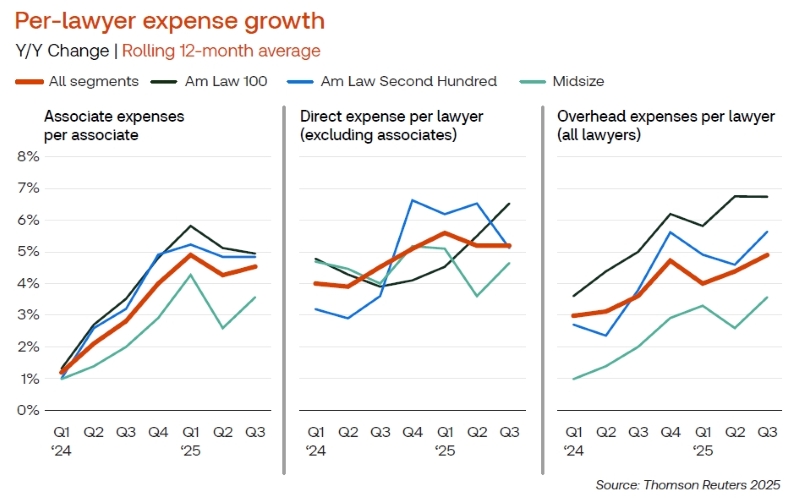
First, expenses are now rising faster than rates, and expense growth is accelerating. Direct costs are up 8.5% year-over-year, while overhead expenses climbed 7.5%, according to Q3 LFFI data. This is an extremely risky proposition because expense growth is generally sticky and hard to control, especially during intense growth periods because firms feel they need to continue feeding the human capital and overhead infrastructure that is driving growth.
However, history teaches a harsh lesson: Revenue can vanish overnight, but expenses rarely do.
Second, realization is wobbling in troubling ways. Firms saw an unseasonal downtick in collection realization in Q2, counter to normal seasonal patterns in which realization typically improves throughout the year. This wobble may feel uncomfortably familiar to anyone who survived the aftermath of the global financial crisis that began in 2007. While Q3 showed some recovery in realization, the long-term trend since 2021 has been a slow decline, which means that despite record standard rate increases, the percentage of those rates actually collected continues to erode.
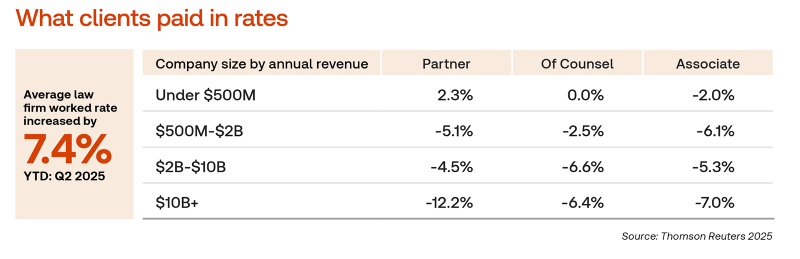
Third, work continues to shift down market. The Rates Report noted that corporate clients with annual revenues of more than $10 billion saw their effective paid rates decline at a double-digit rate in 2025, even as law firms reported average worked rate increases of 7.4%. This reflects how price-sensitive matters had been shifted towards smaller, lower-cost providers while the largest firms seek to retain higher value work.
The challenge then becomes for law firms to identify which matters justify premium pricing and which are vulnerable to downstream migration. Strategic partnerships with smaller firms or alternative legal providers could potentially be an avenue for larger firms to retain client loyalty while protecting their margins.
Looking ahead
While many law firms are enjoying the fruits of a bountiful 2025, it’s not too early for firm leaders to turn their attention to 2026 and determine what their strategies will be. This is no time for complacency or an assumption that next year will merely be a replay of 2025. Instead, firms need to start mapping contingency plans in case demand or pricing falter, expense growth accelerates further, or work continues to flow downstream to lower-cost law firms.
The flashing lights in the distance may turn out to not be celebratory holiday displays but rather caution signs that lie in wait for the year ahead. The warning lights aren’t showing red yet, but they’re definitely moving from a festive green to a cautionary amber.
You can download a copy of the Thomson Reuters Institute’s Law Firm Rates Report 2026 here