
Law students are already sophisticated and self-aware about AI in their recognition of both its professional necessity and its risks; however, their legal institutions may not be keeping pace, leaving students to be self-taught and inconsistently prepared at a critical moment for the legal profession, a new white paper reveals
Executive Summary
Key takeaways
- Almost three-quarters (72%) of students surveyed say they see AI literacy as essential, while an even larger portion (74%) say they also recognize the risks of over-reliance.
- Almost 6 in 10 law students use AI several times per week for academic work, but much of this learning is happening through self-education rather than structured teaching.
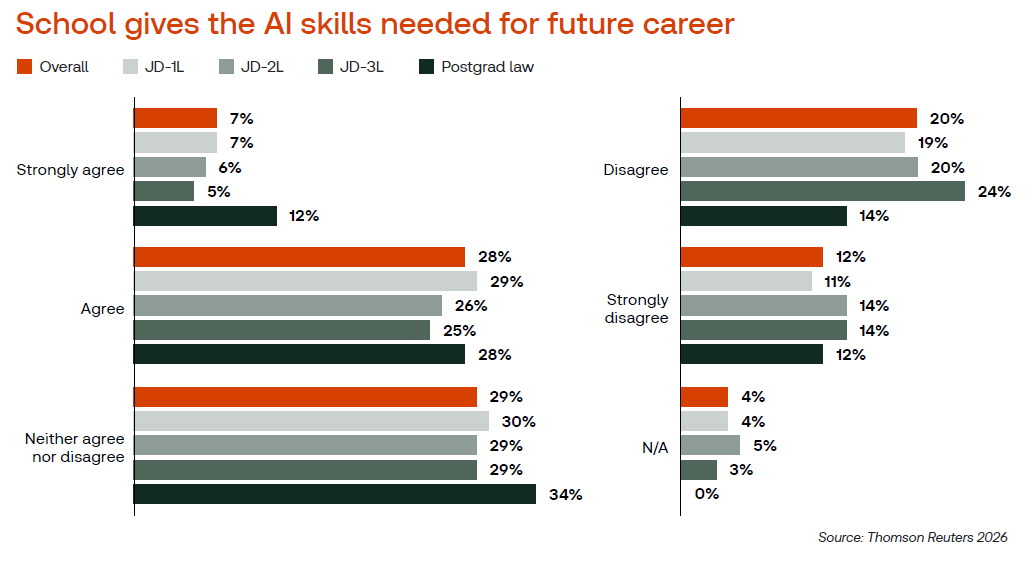
- Close to a majority (48%) of students report that AI policies vary by professor, and almost one-third (32%) say that their schools do not give them the AI skills needed for their future career.
There is a significant and growing divide between how law students understand artificial intelligence and how legal institutions, such as law schools, are responding to it, according to a new Thomson Reuters Institute white paper.
The 2026 Law Student Pulse Survey, based on responses from more than 1,800 law students that were collected in April 2026, challenges two assumptions that have long dominated institutional thinking. The first is that students are reckless adopters who use AI to bypass the hard cognitive work of legal education. The second is that students are passive and uninformed consumers of a technology they do not fully grasp. The data shows that neither characterization is accurate.
In reality, 72% of responding students identify AI literacy as an essential professional skill, while 74% simultaneously acknowledge that over-reliance on AI could undermine the development of their own core legal competencies. Holding both of these positions in tandem reflects a level of professional maturity that many institutions have yet to demonstrate in their own policies and curricula.
The survey also exposes a serious institutional gap. Nearly one-third of students report that their school does not provide the AI skills needed for their future legal careers. And nearly half indicate that AI policies vary by professor, leaving students without coherent and consistent institutional guidance on what responsible AI use actually looks like.
Far-reaching consequences
The consequences of this AI-understanding gap extend well beyond the classroom. Students are entering the workforce self-taught and inconsistently prepared, at a moment when legal employers are moving quickly to embed AI fluency into their hiring and development expectations. The profession is at risk of producing graduates who are sophisticated enough to recognize the stakes but underprepared to meet them.
The full white paper outlines specific, actionable recommendations for law schools, bar associations and accreditors, and legal employers to follow to better address this gap in AI understanding.
You can access the full 2026 Law Student Pulse Survey, here
Follow us on social
Topics
Have questions?

Featured Event
The 34th Annual Chief Marketing & Business Development Officer Forum
