
The AI boom promises transformative gains for law firms, but their success hinges on disciplined investment and transparency, and it will be those firms that align technology with practical returns that will thrive if the AI bubble bursts
Key takeaways:
-
-
-
Industry-wide AI investment brings risk — Law firms are navigating the effects of a broader, industry-wide surge in AI investment that has sparked speculation about a potential AI bubble, which suggests firms may need to reconsider aspects of their current strategic approach.
-
Strategic AI adoption leads to better returns — Firms that implement AI thoughtfully and strategically see greater, tangible returns, while those adopting AI superficially or mainly to justify higher billing rates could be more exposed if the bubble were to burst.
-
Long-term stability requires clear client value — Long-term stability hinges on making sure AI investments provide clear, measurable value and improved efficiency to clients, with transparency and client outcomes remaining central as law firms adapt to this period of heightened AI enthusiasm and uncertainty.
-
-
The newly released 2026 Report on the State of the US Legal Market, published jointly by the Thomson Reuters® Institute and the Center on Ethics and the Legal Profession at Georgetown Law, shows law firms enjoying strong demand and record profits throughout the past year.
Indeed, for the average firm, this feels like a golden moment — clients are spending, rates are climbing, and AI investments promise a competitive edge. However, the report also illustrated how much of this growth is built on unstable ground. As firms race to adopt AI and advanced technology, they face new risks if they fail to use these tools wisely or don’t deliver clear value to clients. Success for many law firms now depends on rethinking business models, focusing on client needs, and ensuring technology investments create lasting stability.
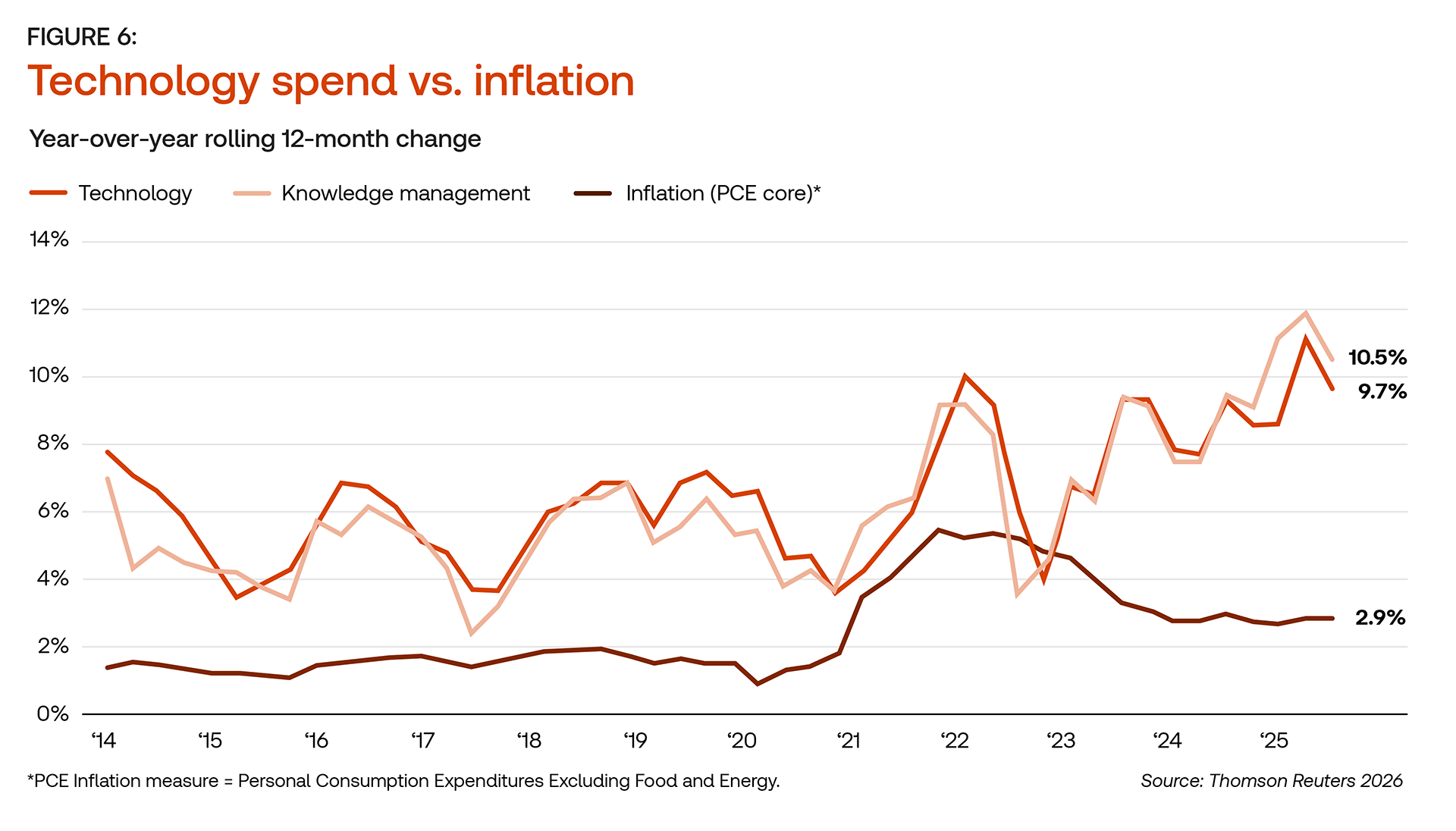
This ramped-up competition has pressed law firms towards unprecedented growth in their spending on technology and knowledge management, with firms increasing their investments by nearly 11% and 10% in 2025, respectively — far outpacing inflation and 2024’s levels. This surge is driven by an arms race to adopt advanced AI solutions, particularly generative AI (GenAI), which promises to fundamentally transform how legal work is performed. Yet, the real winners may not be those firms that spend the most, but rather those that deploy AI strategically.
And, as past Thomson Reuters research showed, law firms with a clear AI strategy are almost four times more likely to see tangible returns on investment. To understand why this optimism could be risky, let’s look at what’s fueling the AI frenzy.
AI hype in the legal sector
The legal industry in recent years has seen an explosion of interest and investment in AI. Industry enthusiasm mirrors the broader AI boom, which has attracted an estimated $1.6 trillion in global investment since 2013, with $375 billion forecast for 2025 alone — a scale that’s surpassed historic projects like the Apollo space program. This enthusiasm stems from the belief that AI can significantly improve efficiency, as GenAI can draft documents, analyze contracts, synthesize summaries of complex topics, and even support legal decision-making.
Amid this surge in adoption and funding, concerns are mounting that the legal industry could be swept up in an AI bubble. If this bubble pops, investor sentiment sours, or funding gets curtailed, the average law firm could face a sharp slowdown in demand for premium services as client budgets tighten. Those firms heavily invested in AI without clear plan for return on investment (ROI) would be exposed to higher costs, lower utilization, and strong pressure to cut rates. These risks are amplified when AI is adopted superficially, such as using it merely to justify higher billing without improving outcomes.
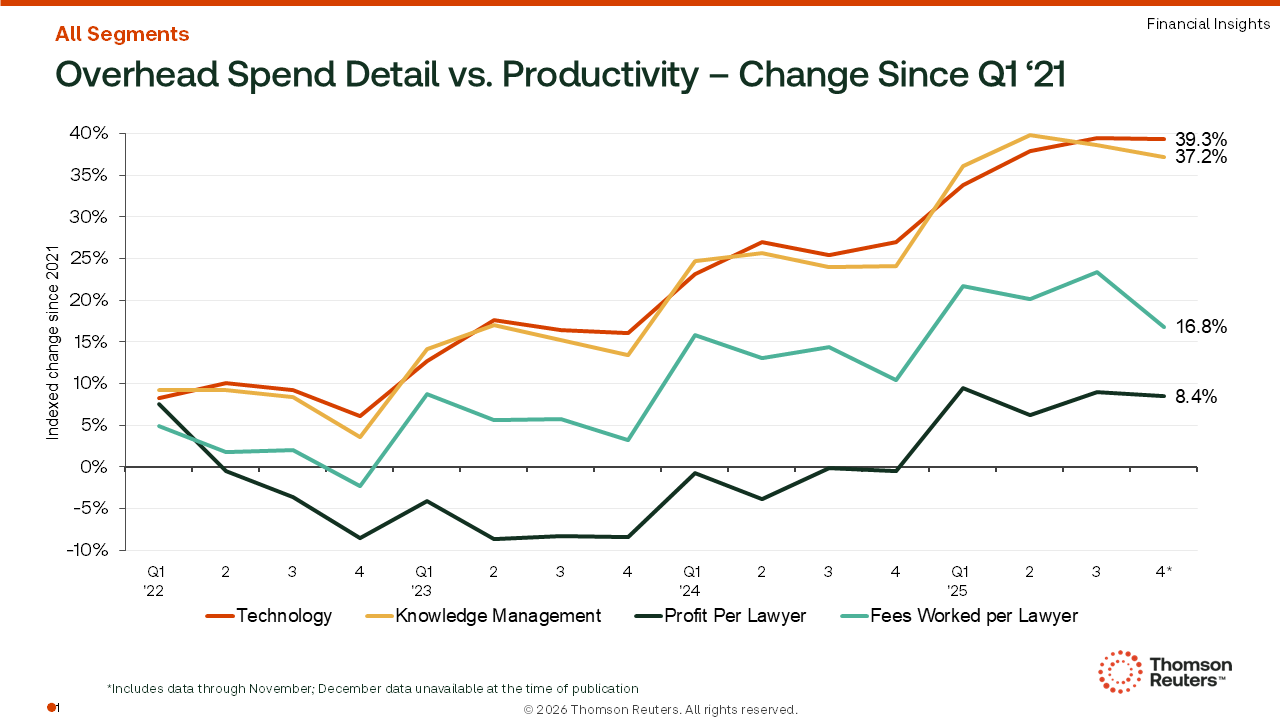
Indeed, the issue becomes even more concerning when considering the magnitude of recent investments. From 2021 to 2025, law firms dramatically ramped up their technology investments, increasing their tech spending by an impressive 39.3% over those four years. This surge in spending is measured against firms’ technology spending levels in 2021 — the year before GenAI became widely available. Knowledge management investments, closely tied to AI capabilities, followed a similar trajectory, with investment growth in that area surging 37.2% over the same period. These aren’t modest upgrades; rather, it’s a clear indication that firms are pouring resources into AI at an unprecedented rate.
If a sharp correction in the broader economy — like the AI bubble bursting — would occur, it would greatly strain client budgets, forcing organizations to cut costs and scrutinize their outside legal spending. As budgets tighten, clients will seek better value at lower price points, intensifying competition among firms and pushing outside lawyers to justify every dollar of their rates. Those firms that rely on premium pricing without delivering measurable efficiency gains will be the most exposed.
In fact, these vulnerabilities become clearer when we look at the numbers. Profit per lawyer rose by 8.4% above pre-2022 levels by the end of 2025, and fees worked per lawyer climbed an even greater 16.8%. However, most of that growth came from rate hikes, not necessarily operational improvements.
You can hear more about the “2026 Report on the State of the US Legal Market” in the latest episode of Clarity, a Thomson Reuters Institute podcast, on YouTube
Some analysts argue that record-high rates could signal efficiency gains — if lawyers accomplish in one hour what previously took them 10, then the value delivered may justify the price. However, a $2,000-per-hour associate rate during a downturn could create sticker shock that could push clients toward lower-cost firms or in-house solutions. This dynamic underscores the risk of relying on pricing power instead of demonstrable value creation. In other words, today’s profitability hides a structural weakness: If client budgets tighten, those law firms leaning on rate increases rather than operational improvements will be the first to feel the pain.
Therefore, preparing for this scenario requires more than maintaining profitability. The real test of AI investment is whether it delivers measurable improvements for clients. Premium billing tied to AI adoption is sustainable only when clients clearly see added value. Firms that invest heavily in AI without translating those investments into efficiency and outcomes risk losing ground. The priority now for law firms should be to align their technology with client needs, demonstrate tangible benefits, and maintain transparency to preserve trust in an increasingly competitive market.
Assessing the payoff: AI value vs. AI bubble
By the end of 2025, law firms were allocating almost 40% more to their technology budgets than before the rise of GenAI. The ideal scenario for AI adoption would involve a brief, manageable dip in productivity as professionals adapt, followed by lasting efficiency gains. The reality, however, is more complex. Fees worked per lawyer have surged, even outpacing profit growth, driven largely by rate increases. Although higher rates can reflect efficiency gains when work is completed faster and with greater precision, they also create vulnerability if clients perceive them as a pure pricing move. Firms that fail to translate AI-derived gains into clear, measurable value may risk feeling strong pressure as client push back.
That brings us to a simple math equation that was underscored in the State of the US Legal Market Report: Will the practical returns — such as ROI — genuinely outpace the massive sums being funneled into AI investment?
This is ultimately a question of balancing costs and benefits, of course; but if the AI bubble bursts and prices soar, fast action will be required. And it will be those firms who guided their use of AI to generate greater value and thus higher profits that will come out ahead. In other words, if the value delivered by AI exceeds its cost, law firms are well positioned to weather even dramatic market shifts, making their AI strategies sound regardless of broader industry volatility.
You can download a full copy of the 2026 Report on the State of the US Legal Market, published jointly by the Thomson Reuters® Institute and the Center on Ethics and the Legal Profession at Georgetown Law, here