
Even as demand surges and financial indicators rise, law firms face a quieter challenge of persistent expenses. Understanding how costs linger — especially when demand fades — is key to building a resilient firm in a dynamic market
Key takeaways:
-
-
-
Growth isn’t free — While direct expenses have stabilized, overhead expenses continue to climb. These costs often don’t fall as fast as demand, creating long-term financial pressure if demand should contract.
-
Different strategies have same risk — Am Law 100 firms invest steadily, while Second Hundred firms move variably, and Midsize firms tread cautiously. Despite these different approaches, all segments are raising expense levels that may outlast demand spikes.
-
Expense stickiness is a strategic challenge — Law firms must plan beyond the current boom. Expense stickiness means costs may linger even when work slows, making smart hiring, tech investment, and cost control essential in order to weather future downturns.
-
-
Even as tectonic pressures continue to mount, law firms reached new heights in the third quarter of 2025. The Thomson Reuters® Institute’s Law Firm Financial Index (LFFI) rose solidly, driven by a historic spike in legal demand even amid rising global instability. However, beneath this surge lies a quieter, more persistent challenge, and one that could shape the financial future of firms far more than demand alone: Expense stickiness.
This concept — how higher expenses linger even when demand drops — isn’t new, but it’s becoming increasingly relevant. The latest LFFI data reveals that while firms have made progress in managing associate compensation, they’ve yet to fully address how to handle compensation for other lawyers. Demand growth has been steady throughout 2025 thus far, but if firms want to make a meaningful impact on revenue, they must broaden their focus. Compensation strategies for senior talent and other lawyers as well as for overhead costs all play a role in shaping long-term financial health.
Currently, law firms are facing rapidly rising costs due to headcount growth and increasingly expensive senior talent, with direct expenses rising steadily and overhead — especially spending on technology and knowledge management — accelerating even faster. While associate pay hasn’t surged as it did during the 2021–22 talent wars, firms’ overall expense growth remains high. This sustained investment in talent, tech, and knowledge management — now in its third straight year — is a reminder that while demand can quickly vanish (as seen during the 2022–23 downturn) expenses tend to persist, creating long-term financial risks for firms.
Contrasting growth strategies: How the different segments are managing expenses
The different law firm segments are attempting to manage this expense growth in a variety of ways. For example, Am Law 100 firms have moved confidently and consistently. Their associate compensation rose steadily throughout 2024, peaking in early-2025 before leveling off. The segment’s direct expenses followed a similar arc, climbing quarter by quarter to lead the market. Overhead costs doubled their growth pace during this period, signaling sustained investment. Indeed, the largest law firms didn’t just spend more, they did so with consistency.
Meanwhile, the Am Law Second Hundred firms pushed hard, but their path was less predictable. Compensation for associates and direct expenses surged, especially in late-2024, suggesting bursts of hiring or reactive pay moves. Overhead spending fluctuated, with sharp rises and dips that hint at tactical recalibrations as the year evolved.
Midsize law firms took a more responsive and restrained route even as they pushed hard to bring on more lawyers. Associates’ compensation and direct expenses grew modestly, with a notable dip in mid-2025. Overhead costs remained low and erratic, reflecting tighter budgets and a need for agility. Their spending patterns suggest a careful balancing act — responding to market pressures without overextending as they have in the past.
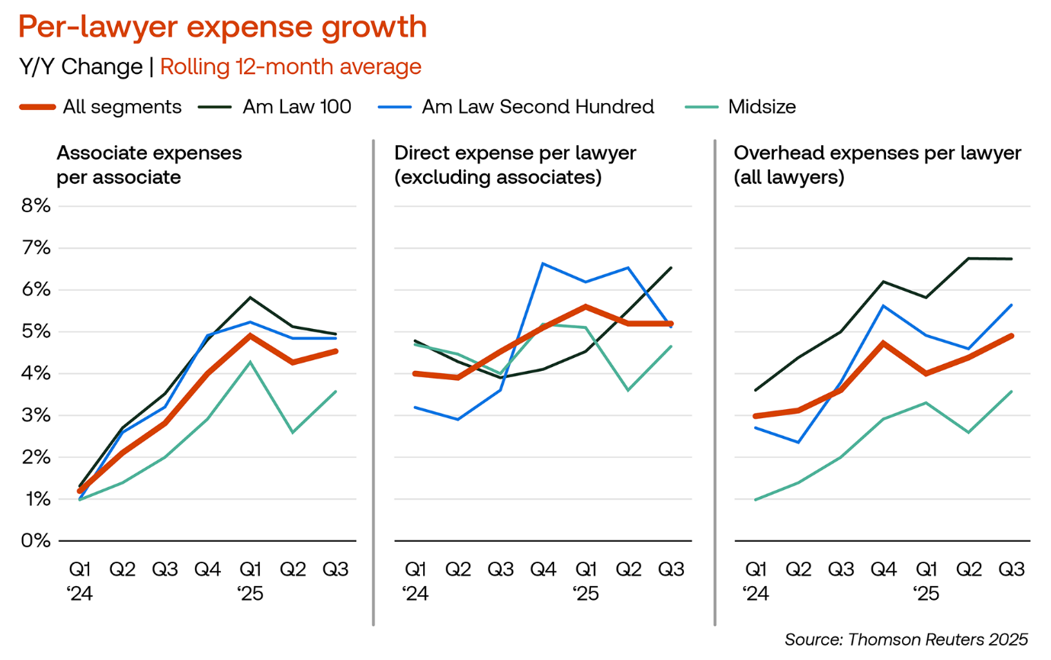
Taken together, the data reveals a broader industry rhythm. Across all segments, 2024 was a crescendo — costs rose in lockstep across both direct and overhead expenses. Yet, the first quarter of 2025 emerged as a pivotal moment, representing the crest of the wave and the peak of investment. What followed is a pause, a plateau, a moment of reflection. The largest firms continued to push forward, while others recalibrated. Now, things seem to again be accelerating and building atop even the heights of 2024.
Expense stickiness: Demand vs. the lag in expenses
In the graphic below, the lower, dark line tracks year-over-year demand growth. As you can see, it climbs sharply in early 2021, reflecting a post-pandemic surge in legal work; however, by late 2022, demand drops dramatically.
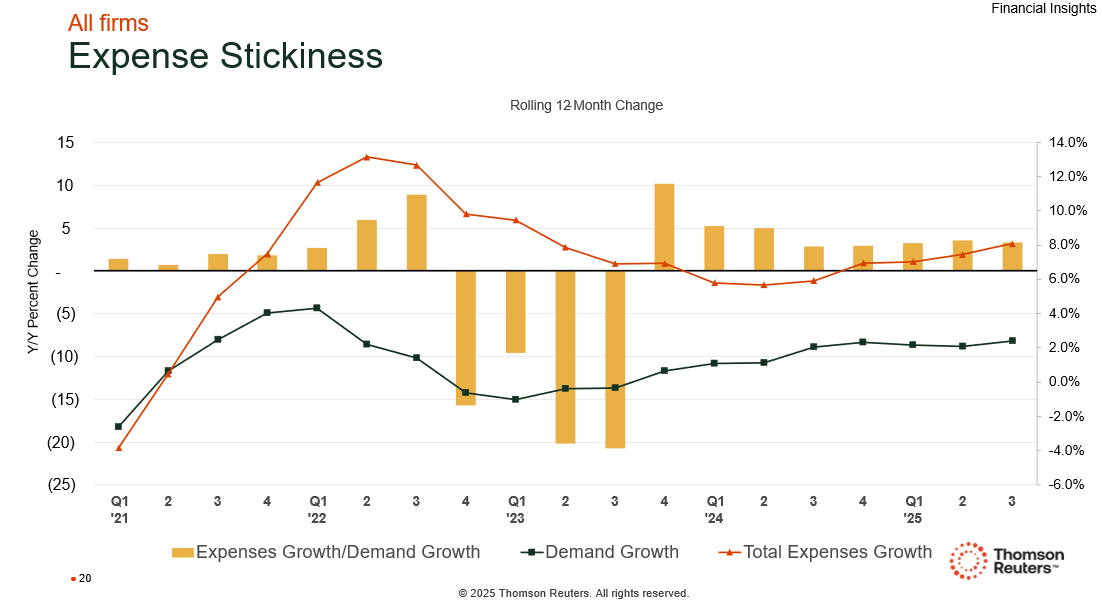
It is these tremors that shake the legal industry, chronicling those times when client activity slows and demand falls. Unlike demand, however, expenses don’t fall as quickly or as deeply. This lag is the essence of stickiness — costs, such as salaries, technology, and other expenses don’t disappear just because the work dries up.
The yellow bars in the graphic represent the stickiness metric, which spikes downward during demand slumps, as seen in late-2022, showing that expenses barely budged, even as demand dropped sharply. In other words, law firms were still paying for their top talent, tech investment, and infrastructure, despite having less work to support those costs.
As the graphic shows, as demand began to recover in 2023, expenses stabilized, and the stickiness metric returned to normal levels. The lesson is clear, however; when demand vanishes overnight, expenses rarely do. That means it is imperative that law firms plan for these moments, ensuring they have strategies to weather downturns without being hung up by persistent costs.
Why this matters: Risk & resilience
This story isn’t just about numbers — rather, it’s about risk and resilience. Law firms operate in a world in which demand can be unpredictable, but expenses are stubborn. Understanding this dynamic helps law firm leaders make smarter decisions about hiring, technology investments, and financial planning. Expense stickiness is more than a financial quirk; it’s a strategic challenge that firms must confront head-on.
You can download a full copy of the Thomson Reuters® Institute’s Law Firm Financial Index for Q3 2025 here