
Law firms are showing resilience amid economic instability in the United States, with regional dynamics driving contrasting strategies among firms in the Southwest and Southeast
Key points:
-
-
-
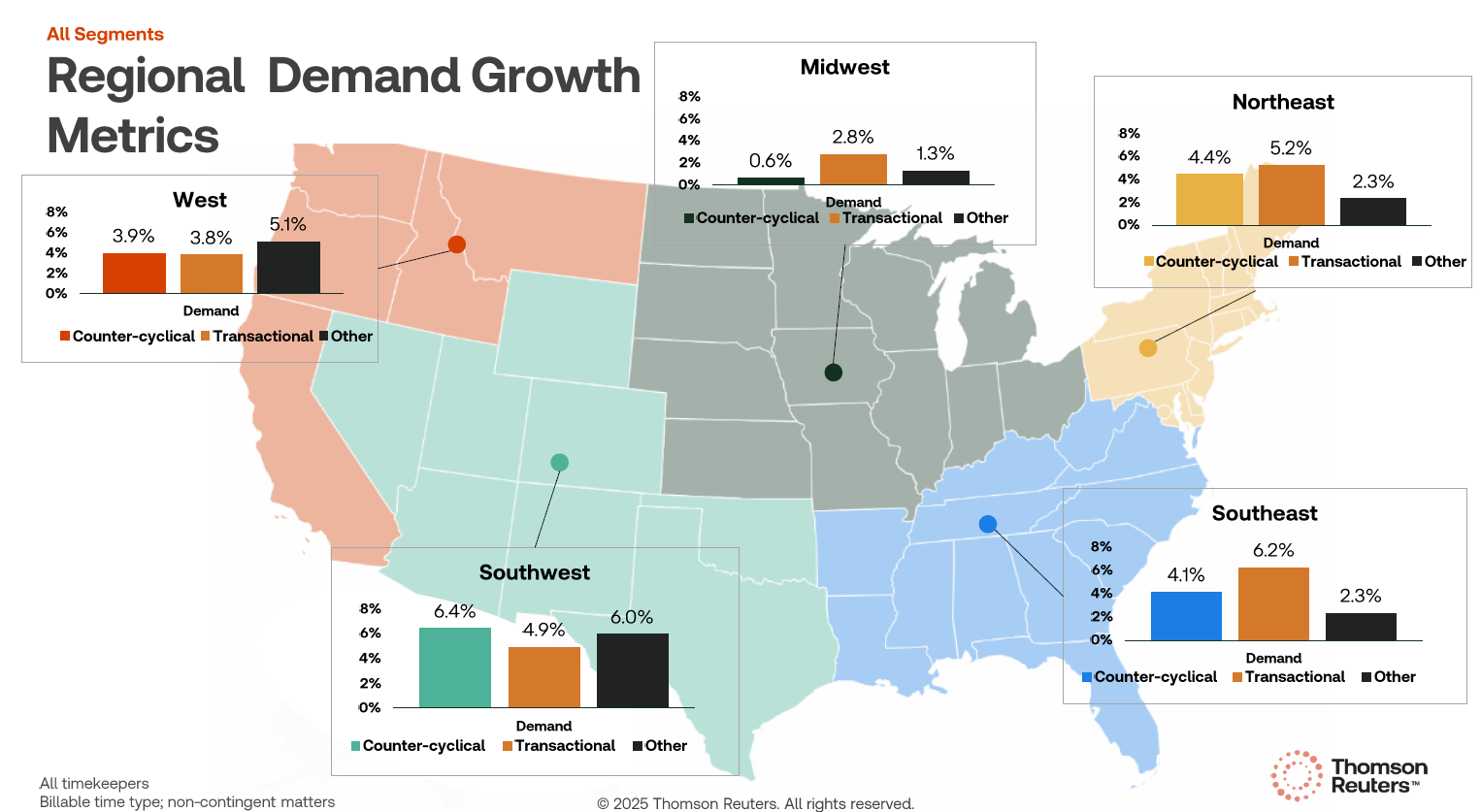
Southwest strength spans all practices — Firms in this region show balanced growth, with labor, litigation, and M&A practices leading the way.
-
Southeast signals dual priorities — Transactional practices such as corporate and real estate remain strong, while bankruptcy is becoming increasingly relevant.
-
Tailored strategies and flexibility drive success — Firms that align with regional strengths while remaining adaptable to shifting economic conditions may be best positioned to thrive in an uncertain future.
-
-
Despite persistent economic and political instability in the United States, law firms are demonstrating remarkable resilience. The Thomson Reuters® Institute’s Law Firm Financial Index (LFFI) climbed to 63 points the third quarter, signaling stronger-than-expected performance across the legal industry. This increase reflects a surge in demand, particularly among transactional and counter-cyclical practices, even as broader market volatility continues to raise concerns.
While the overall story for law firms is one of growth, further insights lie beneath the surface, especially in the regional variations that reveal how different parts of the country are responding to the current uncertainty. Two regions, in particular, stand out for their contrasting yet equally compelling narratives: the Southwest and the Southeast.
The Southwest: A model of stability and counter-cyclical strength
The Southwest region of the US has emerged as a beacon of growth in an otherwise uneven market. It is the only region that did not experience contraction in any major practice group in Q3, a remarkable achievement given the economic backdrop. This broad-based strength suggests that firms in the Southwest could be benefitting from a unique combination of factors, including geopolitical ripples and robust client demand across multiple sectors.
Labor & employment practices have experienced a notable upswing. This surge reflects the heightened complexity of workforce issues during times of uncertainty, from regulatory compliance to disputes over layoffs and restructurings. Litigation similarly continues to strengthen, underscoring the strength of counter-cyclical practices in this part of the country.
The mergers & acquisitions practice also has shown remarkable momentum, signaling that businesses in the Southwest are not shying away from strategic transactions despite broader economic challenges. In fact, this resilience may reflect structural and political dynamics. Southwestern states — often aligned with pro-business policies — could be benefiting from preferential treatment under an administration that favors red states over blue states. Such advantages may translate into stronger economic performance and, consequently, increased legal spending in transactional practice areas.
The Southeast: Transactional momentum amid signs of stress
The Southwest, on the other hand, reflects a narrative of steadiness, as the region maintains a consistent performance across key practice areas. For example, bankruptcy has emerged as a key area of growth in the Southeast, making this region unique in showing increased activity in insolvency matters.
This duality — strong corporate and real estate activity alongside rising insolvency work — highlights the complexity of regional economic conditions. For law firms, it also underscores the importance of maintaining a balanced portfolio of practices to allow them to navigate both opportunity and risk.
The Southeast’s performance also raises questions about the durability of its transactional momentum. Will corporate and real estate growth continue if bankruptcy trends accelerate? Will bankruptcy demand decline? These are critical considerations for firm leaders in this region as they make strategic plans for the months ahead.
Regional divergence and its implications
The contrast between the Southwest and Southeast illustrates a broader truth: Regional dynamics matter, while national averages can obscure the localized realities that shape client demand and law firm performance. In the Southwest, the absence of contraction across any of the major practices suggests a level of economic resilience that other regions may struggle to match. In the Southeast, the coexistence of transactional strength and financial distress may indicate a more volatile environment in which opportunities and risks are closely intertwined.
For law firms, these patterns carry significant strategic implications. Firms operating in the Southwest may prioritize investments in labor & employment and litigation capabilities to sustain counter-cyclical strength, while continuing to capitalize on M&A opportunities. In the Southeast, firms may need to adopt a dual strategy — supporting transactional practices while expanding expertise in bankruptcy and restructuring to meet rising demand. It’s critical to note that current growth patterns do not guarantee long-term demand.
Navigating an uncertain future
As law firms plan for the next quarter and beyond, the question is not whether regional differences will persist but how firms can best adapt to them. Continued economic and political volatility could sustain demand for counter-cyclical practices nationwide, while transactional activity may fluctuate based on business confidence and capital availability.
Those law firms that succeed will be those that embrace agility and regional specialization. Understanding local economic drivers, anticipating shifts in client needs, and aligning resources accordingly will be critical.
You can download a full copy of the Thomson Reuters Institute’s Q3 2025 Law Firm Financial Index here