
Exploring outcome-based pricing, especially as AI transforms legal work, requires a renewed focus on client trust and unwavering quality, both of which depend on responsible AI use and transparency
Key takeaways:
-
-
-
AI allows lawyers to work on more complex matters — By streamlining routine legal tasks, AI enables lawyers to focus on higher-value work, which then revives market interest in outcome-based pricing models.
-
Establishing trust with AI is critical — Building client trust with AI means providing clear explanations, maintaining open communication, and ensuring that human judgment remains central to the legal process.
-
Keeping an eye on AI’s work quality — Declines in quality from AI-assisted work can make clients question the value of legal services.
-
-
As AI becomes part of everyday legal work, the traditional way of charging clients by the hour may be long past its expiration date. And as the Thomson Reuters Institute’s 2025 State of the US Legal Market Report argues, this change isn’t just about using new tools — it’s about redefining how legal value is delivered.
A new opportunity to bill based on value
For many years, the billable hour has held sway in the legal industry; and while this method is familiar, it is falling behind how legal work is increasingly being performed today. AI now supports tasks like document review, legal research, and drafting, reducing the time lawyers spend on routine work and creating more opportunities for higher-value work.
As a result, a seemingly stagnated theory of pricing is once again gaining ground — one that focuses on outcomes instead of hours. In this model, clients pay for what gets accomplished: resolving a dispute, drafting a contract, or ensuring compliance with regulations.
This approach ultimately strengthens the relationship between firms and clients. It rewards results, encourages clear communication, and makes pricing more predictable and fair. However, this shift also brings new challenges for law firms and their clients, especially around trust and quality.
Building client trust using AI tools
Clearly, clients benefit from faster and more cost-effective legal services; however, they also need to trust that the work they receive from outside counsel is accurate and meets professional standards, even — or perhaps especially — when AI is involved.
To build that trust, AI systems must be used responsibly. Lawyers using AI should be able to provide clear explanations of how they reached conclusions, keep records of their steps, and always involve a human review and approval of the final work. Clients don’t need to understand every intricacy of the technology of course, but they do need to know that the process is safe, ethical, and well-managed.
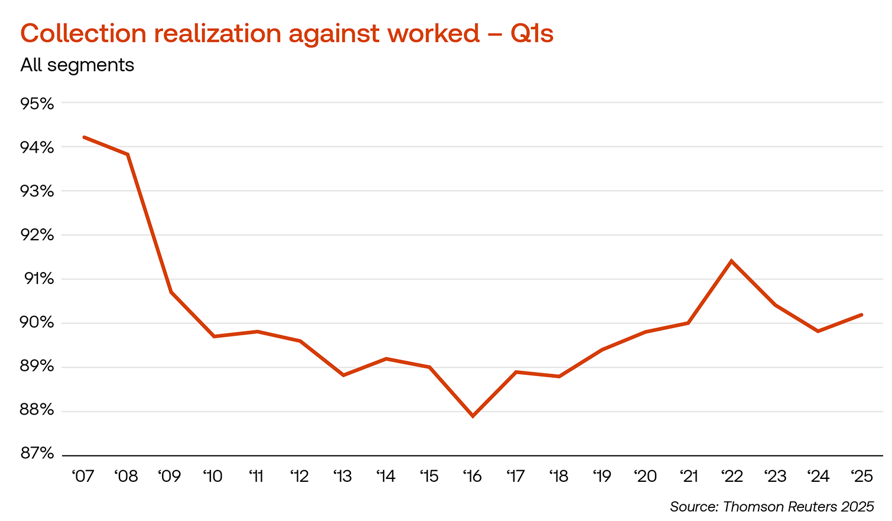
Many law firms are already using AI tools in their daily work. While these tools can improve efficiency, it’s important to not assume that clients will always be comfortable with them. One way to monitor this is by looking at the realization rate in fees, especially the difference between what the client actually agreed to and what was actually collected. This metric can show to what degree clients may be pushing back on service they feel didn’t meet expectations.
Over the past three years, realization rates have remained steady, just above 90% — however, that doesn’t mean there’s no risk. If AI is used carelessly, the quality of work could suffer, and clients may start to question their bill. That’s why it’s essential to use AI with clear processes and human oversight, so it supports the value that clients expect rather than creating problems for the firm and the client.
Declines in quality can lead to doubts about value
As AI becomes more commonplace in legal processes, the quality and reliability of submissions must remain high. This matters not only for the fairness of proceedings, but also for how legal services are valued.
If AI-generated documents are submitted without proper review or contain errors, it can lead to delays, rejections, or even sanctions. These outcomes affect the perceived value of legal services and can undermine client trust, especially in an outcome-based pricing model, where results matter more than effort.
To support this shift in pricing, legal professionals must ensure that AI-assisted work meets the same standards as their traditional submissions. This includes verifying sources, disclosing AI use when appropriate, and maintaining human oversight. By doing so, law firms protect the quality of their work and reinforce the value they had promised to deliver.
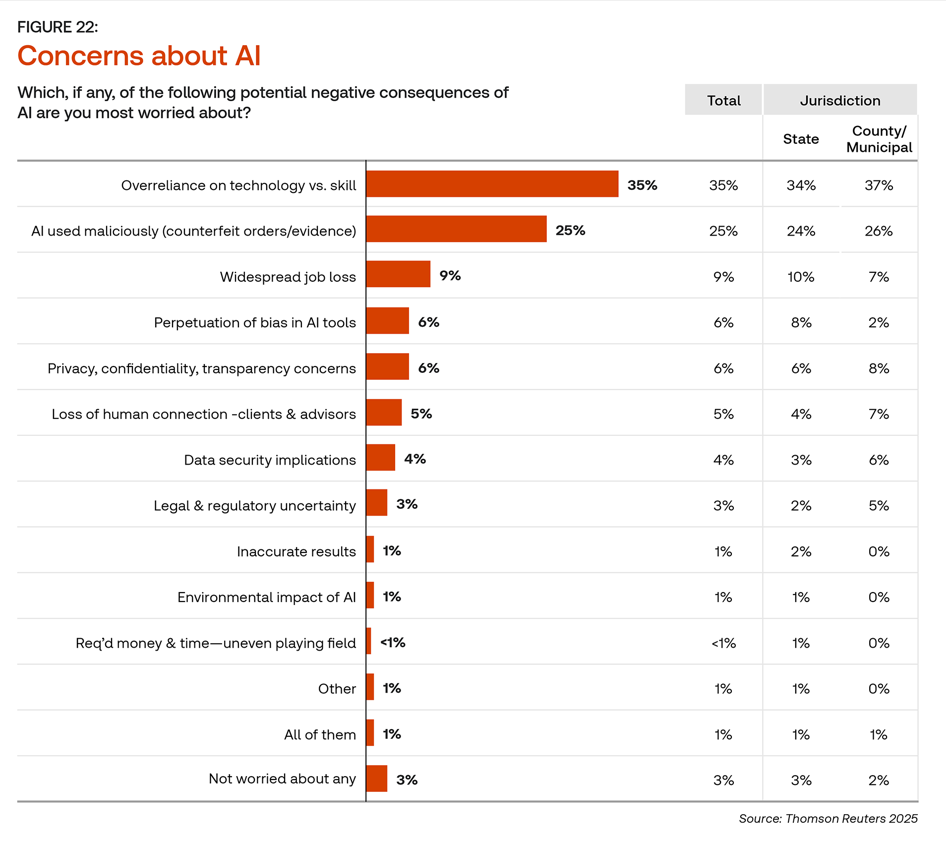
According to the Thomson Reuters Institute’s 2025 survey of state courts, many in the legal profession already are thinking about these issues. The top concern — shared by 35% of judges and court staff professionals who were surveyed — is that people may rely too much on technology and lose essential skills. Another 25% said they worry about AI being misused, such as by generating fake legal documents or false evidence.
These concerns highlight the need for clear standards and responsible AI use — not just to protect the legal process, but to support the shift toward pricing models that are based on trust and outcomes.
What the legal industry needs from AI
To enable the transition to outcome-based pricing, the legal industry needs AI systems that do more than just answer questions. These tools should be able to plan, reason, and complete complex legal tasks. They must be easy to understand, explain their results, and fit naturally into legal workflows. Most importantly, they should always allow for human judgment.
These systems should be built with expert knowledge, trusted legal content, and strong ethical standards. Indeed, these AI-driven technologies aren’t just tools, rather they’re partners that help legal professionals do their work better. In fact, moving from billable hours to outcome-based pricing is more than a change in billing — it’s a new way of thinking about legal work.
As AI continues to evolve, lawyers will spend more time on strategy and client relationships. And that’s good, because the future of legal work isn’t about doing more, it’s about doing better — and that future is already taking shape.
You can download a full copy of the Thomson Reuters Institute’s 2025 State of the US Legal Market Report here