
Law firms can no longer rely on reputation alone, sustainable pricing power now requires consistently demonstrating measurable value to clients at every stage of the relationship
Key insights:
-
-
-
Pricing power now depends on clear, measurable value — Firms must prove their worth at every client touchpoint to justify charging premium rates.
-
Value delivery spans five critical stages — Demand management, service design, delivery excellence, value capture, and relationship management. All must be systematically audited and improved.
-
Action is essential — Diagnosing gaps is only the first step; law firms must assign accountability, set goals, and continuously adapt to meet evolving client expectations and avoid competing solely on price.
-
-
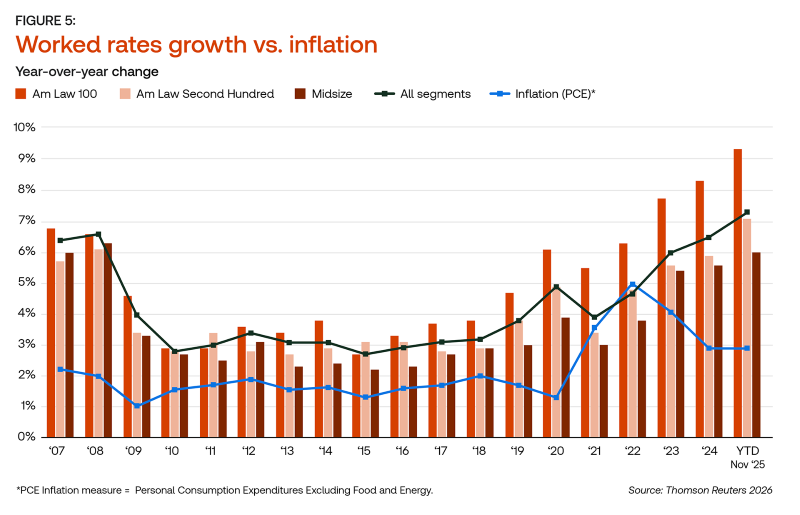
The 2026 Report on the State of the US Legal Market, published jointly by the Thomson Reuters® Institute and the Center on Ethics and the Legal Profession at Georgetown Law, shows that over the past three years, legal industry pricing has skyrocketed at an unprecedented pace.
Many law firms have enjoyed strong demand and the ability to command higher rates, often without significant pushbacks from clients. However, that era of unchecked growth is coming to an end. Today’s clients are far more discerning about what they are willing to pay for and why. More often, they scrutinize every invoice, questioning whether the value delivered truly matches the premium price charged.
The danger for many law firms is complacency. Past success can create a false sense of security, leading to assumptions that reputation alone will sustain pricing power. However, as client procurement teams become more sophisticated and alternative legal services providers enter the market, firms that fail to prove their worth will find themselves competing on cost, which can result in a race to the bottom that few can afford.
This shift signals a fundamental change in the market in which pricing power is no longer guaranteed by reputation or past performance. Instead, pricing power hinges on a firm’s ability to demonstrate clear, measurable value at every stage of the client relationship. Those firms that fail to adapt risk being forced into price-based competition, eroding margins and undermining long-term sustainability.
By 2025, even as inflation eased to a more typical — but still elevated — 3%, many law firms continued to push rate increases at more than twice that level. The disconnect between pricing and underlying economic conditions had widened into a significant gulf, underscoring the critical need for firms to clearly demonstrate and defend the value behind their premium rates.
So, how can firms ensure they are delivering premium value to earn the right to charge premium rates? The answer lies in systematically diagnosing where value is created — and where it is destroyed — across the entire client experience journey.
The 5 stages of legal service delivery
To maintain pricing power, firms must examine their service delivery through five key client experience stages. Each stage represents an opportunity to create value or destroy it.
1. Demand management
Do you truly understand the client’s business problem, or are you focused solely on the legal question? Effective demand management requires moving beyond transactional requests to uncover a client’s strategic objectives. This ensures the solutions proposed align with business impact, not just technical compliance.
You can hear more about the “2026 Report on the State of the US Legal Market” in a recent episode of Clarity, a Thomson Reuters Institute podcast, on YouTube
Start every engagement by asking: What client business goal is driving this need?, What constraints is the client operating under?, and How will success be measured beyond legal compliance? These questions can reframe the conversation from a focus on deliverables to a focus on strategic results, positioning your law firm as a proactive partner in the client’s success.
By facilitating co-design workshops with clients and requiring clear documentation of business goals for each project, your firm ensures that every initiative is aligned with measurable impact. This approach not only demonstrates leadership and a deep understanding of client needs, but it also builds lasting trust and drives greater value throughout the relationship.
2. Service design
Are your offerings built around client outcomes or your own internal structure? Many firms design services based on practice groups and billing models, not on what may serve clients best. This can create friction and inefficiency.
Adopting a client-centric design philosophy requires mapping the client journey, identifying pain points, and designing integrated services around client business needs. For instance, bundling advisory and compliance work into outcome-oriented solutions and coordinating delivery through a single relationship manager simplifies decision-making, strengthens trust, and delivers consistent, measurable value throughout the engagement.
3. Delivery excellence
Do you have safeguards that prevent failures before they ever reach the client? Even the most sophisticated legal advice loses its impact if delivery is inconsistent or error prone. Breakdowns in market research, service design, process conformance, or communication don’t just create inefficiencies, they erode client trust and diminish the firm’s perceived value. This is about embedding reliability into your delivery model, so clients don’t have to chase updates, catch errors, or manage deadlines on your behalf.
Invest in quality checks and project management tools and use proactive risk controls —such as early warning systems for potential delays — that provide automatic status updates and clear ownership. These measures signal professionalism and reliability, reinforcing your premium positioning.
4. Value capture
Can clients clearly see and articulate the value you’ve delivered? If your impact is invisible, your pricing will always feel inflated. Many firms struggle to articulate outcomes beyond hours billed, which can leave clients to wonder what they are paying for.
Communicate value in terms that matter to clients. Use outcome-based reporting to show how your work mitigated risk, accelerated timelines, or unlocked opportunities. Record these in quarterly impact reports — because when clients see tangible benefits, they are far more willing to pay premium rates.
5. Relationship management
Do you build trust systematically or hope it happens organically? Trust is the foundation of pricing power, but it doesn’t happen by accident. Firms that rely on personal rapport alone risk inconsistency and vulnerability when key contacts change.
Implement structured feedback loops, client listening programs, and regular value reviews. These mechanisms demonstrate commitment to continuous improvement and deepen client confidence in your firm’s ability to deliver.
Turning insights into action
Assessing your client’s journey is only the first step. The real challenge and opportunity lies in acting on those insights. Start by identifying gaps in the five key stages, then prioritize improvements that will have the greatest impact on client perception and outcomes.
Assign accountability for each stage, set measurable goals, and track progress over time. Consider creating cross-functional teams to break down silos and foster collaboration. Remember, value delivery is not a one-time project; it’s an ongoing discipline that requires vigilance and adaptability.
As the legal market transforms, so do client expectations. Firms that cling to outdated assumptions about pricing power will inevitably find themselves competing on cost alone — a losing strategy in an increasingly crowded and sophisticated marketplace.
You can download a full copy of the 2026 Report on the State of the US Legal Market, published jointly by the Thomson Reuters® Institute and the Center on Ethics and the Legal Profession at Georgetown Law, here