
The Thomson Reuters “Future of Professionals Report 2026” reveals that the broken link between leadership’s AI ambition and what professionals experience every day is the defining opportunity for organizations to retain talent, deliver client value, and build a lasting competitive advantage over the next few years
Key insights:
- The AI strategy-execution gap is an organizational problem, not a tech one — Among professionals whose firm or department has a stated AI strategy, more than half say that either the strategy is not visible on a daily basis or that the organization has no strategic AI direction at all. The human cost of inaction is building faster than most leaders recognize — More than 90% of professionals say they are experiencing some degree of this AI-value disconnect, and among them, one quarter is considering leaving their current organization within two years if things don’t change — at an estimated replacement cost of $232,000 per employee. Disrupted development compounds talent risk for the next generation — The flight risk of experienced professionals creates a compounding multiplier effect on the ability of entry-level talent to develop critical skills.
- The AI strategy-execution gap is an organizational problem, not a tech one — Among professionals whose firm or department has a stated AI strategy, more than half say that either the strategy is not visible on a daily basis or that the organization has no strategic AI direction at all.
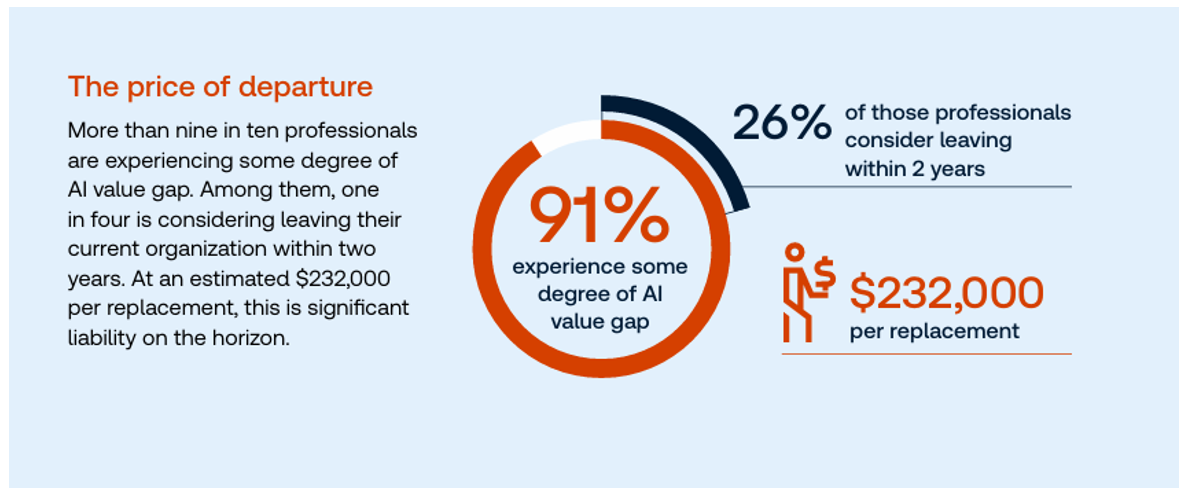
- The human cost of inaction is building faster than most leaders recognize — More than 90% of professionals say they are experiencing some degree of this AI-value disconnect, and among them, one quarter is considering leaving their current organization within two years if things don’t change — at an estimated replacement cost of $232,000 per employee.
- Disrupted development compounds talent risk for the next generation — The flight risk of experienced professionals creates a compounding multiplier effect on the ability of entry-level talent to develop critical skills.
The greatest barrier to AI transformation in professional services is the widening human gap between what organizations promise their people about AI and the spoken and unspoken messages that professionals see and observe in their workplace every day, according to the Thomson Reuters recent Future of Professionals Report 2026, which surveyed more than 1,800 professionals in 62 countries across areas of law, tax, audit, accounting, compliance, risk, and global trade.
Establishing a visible AI strategy
While our research showed that most organizations have a stated AI strategy, the data suggests that it is not translating evenly to employees in their day-to-day work. Among professionals whose firm or department has a formal AI strategy, 35% say that strategy is not visible in their day-to-day experience, and another 17% say their organization has no strategic direction on AI at all. That means that more than half of professionals with fiduciary commitments are working in an environment in which the AI strategy on paper does not match the reality of how their work gets done.
The reasons that professionals say AI strategies are stalling suggest an absence in AI transformation and change agility across the organization. Indeed, professionals say that drivers of their organizations’ struggles to translate AI ambition into measurable results include the fact that the right tools are not yet in place (with 47% of respondents saying this), people are not equipped or trained to work in the intended way (43%), the strategy has not been translated into clear operational priorities (32%), and there is no shared understanding of the AI strategy across the organization (30%).
When strategic clarity around AI exists, it translates into more visible value. In fact, more than two-thirds of professionals in firms and departments with a stated strategy say AI is meeting or exceeding expectations for creating value at work. When there is no understandable AI strategy, less than one-quarter say this.
The quiet accumulation of human costs
The talent consequences of the gap between stated AI strategy and its daily execution are building faster than most leaders recognize. More than 90% of professionals say they are experiencing this gap to some degree. Among them, 1-in-4 is considering leaving their current organization within the next two years if things don’t change. This can result in an estimated replacement cost of $232,000 per employee, which means the quantifiable financial outlay of this talent flight can add up quickly.
The greatest vulnerability of flight risk sits with mid-career professionals, who often are the most embedded AI users, the most influential in day-to-day operations, and the most impatient with slow adoption. Almost 30% of these professionals would change jobs within two years if AI fails to deliver the value they expect, and 14% say they are considering leaving within the next 12 months.
Of course, the financial risks extend beyond mid-career professionals and could in fact disrupt a generation of early career talent. When experienced professionals leave, they take with them the mentorship and oversight upon which the development of early-career employees depends.
The report shows that 71% of professionals say they believe early-career roles need structured support from experienced peers to develop the skills that are at risk of being displaced by AI. Moreover, nearly half say they are concerned about AI’s impact on the development of independent judgment and learning through experience. In fact, legal professionals specifically say they expect the timeline for early-career lawyers to develop a level of trusted judgment could be stretched by nearly two years.
Taken together, these factors create a compounding multiplier effect that will almost certainly have a negative impact on organizational performance in the near future, the report suggests.

Recommended actions for employers and professionals
The Future of Professionals Report 2026 details three distinct paths for how organizations can deploy AI:
- Elevate, which allows AI to handle rote tasks while keeping human expertise at the center;
- Scale, which uses AI primarily to increase capacity without increasing headcount; and
- Reimagine, which puts AI at the core as it rebuilds operating models and service propositions from the ground up.
The data also makes clear that the organizational and human costs of inaction are multifaceted. There are several concrete steps that both employers and professionals can take now, as outlined in the report, which include:
For employers:
- Choose a path and make it visible — The aforementioned three paths represent genuinely different futures with different commercial models, talent strategies, and definitions of professional value. Organizations must choose one deliberately and make it easily visible at the individual and leadership levels. Close the rift in alignment before it results in talent departure — More than one-third of professionals say they are working somewhere where the AI approach does not match their preference. These professionals are almost twice as likely to consider leaving within the next 12 months — and organizational leaders need to be aware of that. Let strategy drive investments — Professionals working in organizations with a stated AI strategy are 3-times more likely to say AI is meeting or exceeding expectations for creating value at work compared to those at organizations without a stated AI strategy. This makes the value of establishing a stated AI strategy and ensuring its visible on a daily basis, a clear step for organizational leadership.
- Choose a path and make it visible — The aforementioned three paths represent genuinely different futures with different commercial models, talent strategies, and definitions of professional value. Organizations must choose one deliberately and make it easily visible at the individual and leadership levels.
- Close the rift in alignment before it results in talent departure — More than one-third of professionals say they are working somewhere where the AI approach does not match their preference. These professionals are almost twice as likely to consider leaving within the next 12 months — and organizational leaders need to be aware of that.
- Let strategy drive investments — Professionals working in organizations with a stated AI strategy are 3-times more likely to say AI is meeting or exceeding expectations for creating value at work compared to those at organizations without a stated AI strategy. This makes the value of establishing a stated AI strategy and ensuring its visible on a daily basis, a clear step for organizational leadership.
For professionals:
- Know which future you are working toward — Almost all professionals say they can see a future in one of the three paths. Understanding which one fits you is the first step to having a productive conversation about where the inconsistency is between your preference and your organization’s direction. Invest in judgment as well as AI tool fluency — Judgment will always be a human differentiator in regard to AI, and the judgment that professionals apply on top of AI competency is what builds lasting professional value.
- Know which future you are working toward — Almost all professionals say they can see a future in one of the three paths. Understanding which one fits you is the first step to having a productive conversation about where the inconsistency is between your preference and your organization’s direction.
- Invest in judgment as well as AI tool fluency — Judgment will always be a human differentiator in regard to AI, and the judgment that professionals apply on top of AI competency is what builds lasting professional value.
Professionals and organizational leaders need to make decisions in regard to their relationship with AI — and these decisions will determine the future of professional services. Those employers and professionals that choose their path deliberately, work to ensure alignment between strategy and experience, and invest in human judgment as seriously as they invest in technology will be the ones that can turn AI’s promise into a competitive advantage that compounds over time.
You can explore the full Thomson Reuters Future of Professionals 2026 report here
Follow us on social
Topics
Have questions?