
Law firms are using vastly different strategies around billing rates, discounts, and realization in order to try to drive better firm performance
Key takeaways
-
-
-
Rate strategies can mask performance —Rate and realization strategies can make it unclear how they affect the bottom line and what is actually driving firm performance.
-
Firms use vastly differing rates and discount strategies — Many law firms are taking various approaches to better balance different strategic goals around profitability and performance.
-
Firms need to understand their rate system configuration — Law firm leaders need to better understand how their rates and realization form an interconnected system.
-
-
Law firm leaders, practice group heads, and firm pricing teams go through countless discussions about setting rates, realization targets, and collection metrics. The conversation often devolves into debates about how much standard rates can be raised, how much to discount those rates, and how aggressively to apply write-downs or write-offs before submitting invoices to clients.
In fact, firms use vastly different rate and realization strategies in an attempt to better balance benefits and costs, according to the Thomson Reuters Institute’s recent Law Firm Rates Report 2026, which took a closer look at how law firms diverge in how they manage these different strategies. Understanding which configuration a firm runs — and why — can be key to effectively managing revenues in today’s legal market.
The 4-stage system
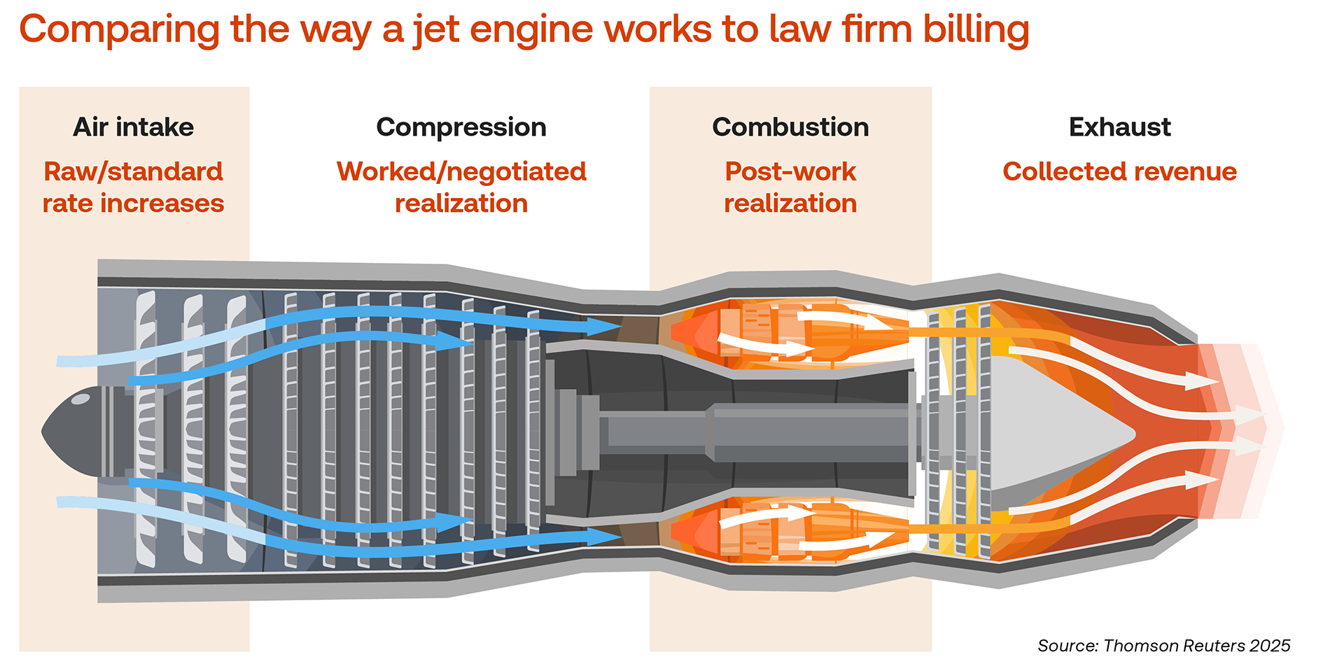
Think of a firm’s rate and realization as an integrated system having four sequential stages, similar to the operation of a jet engine. Inputs flow through multiple processing steps before emerging as collected revenue that powers the next cycle.
Stage 1: Standard rate increases (Intake)
This is where raw potential enters the billing system; and like a jet intake, standard rates determine how much volume enters the system.
These standard rates are the foundation — the starting point that feeds everything downstream. Some firms set aggressive annual increases of 10% to 15% on their standard rates, while others in the same market segment may push more modest 3% to 5% bumps.
This intake volume goes a long ways to determining how smoothly the following stages work. Set rates too aggressively without the infrastructure to support them, and it creates client resistance and downstream problems. Set rates too conservatively, and the rest of the system will be starved of the inputs needed to generate strong performance.
Stage 2: Pre-work realization (Compression)
At the compression stage of a jet engine, air gets squeezed down so that the remaining stages can use it efficiently.
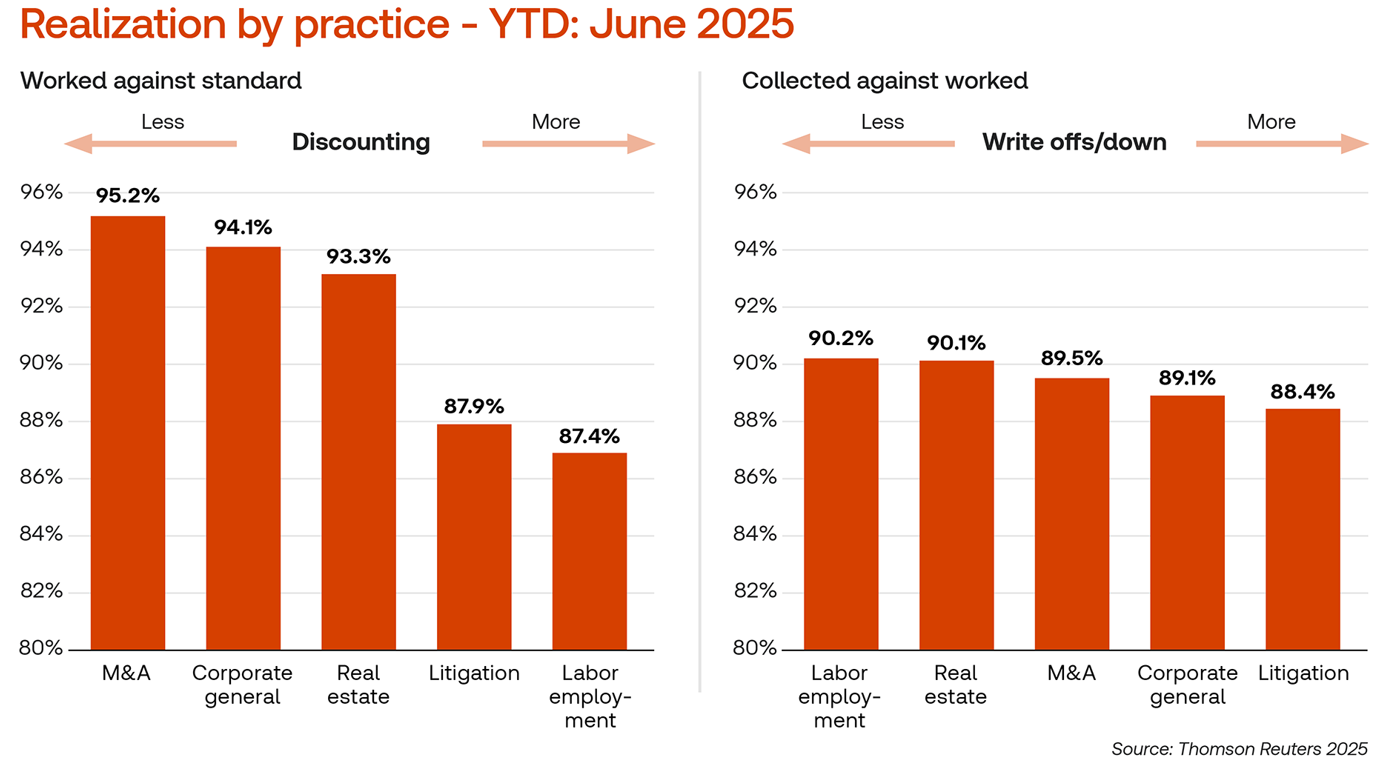
For law firms, this is the critical stage in which standard rates meet the reality of client negotiations and market forces. Some firms utilize high-compression systems by limiting pre-work discounts and maintaining worked realization as high as 95%. Other firms operate low-compression models, immediately releasing pressure through aggressive discounts that can bring realization down to 75% to 80% before work on matters even starts.
Stage 3: Post-work realization (Combustion)
This is where strategy meets execution. For jet engines, it’s where the massive amount of intake air is put to work by mixing with fuel and igniting into power. At the same time, some of the air is allowed to bypass the combustion chamber, helping maintain the optimal operating temperature.
Similarly, firms can apply write-downs after the matter is completed and worked hours are logged with the goal being to optimize billing for the current market conditions. Firms pushing for 100% post-work realization every time (pushing the engine too hard) might maximize revenue per transaction, but risk damaging client relationships over the long-term. Write-downs — particularly on associate work — can function as a buffer that protects higher partner rates from client pushback and preserves long-term relationships. Like a jet engine, some level of what initially could be seen as inefficiency may actually protect the engine.
Also, just as jet engines must be engineered to balance tradeoffs between compression ratios (Stage 2) and air bypass ratios (Stage 3), firm leaders must decide how to balance pre-work vs. post-work realization, even fine-tuning by timekeeper level or practice, according to how they feel they can best generate revenue more efficiently.
Stage 4: Collected revenue (Thrust)
This final stage produces thrust — the collected revenues that drive a firm — however, this doesn’t represent the end of the process. As the hot gases blast out the back of the jet engine, they also spin turbines on their way out, powering the air intake and compressor blades up front, creating a self-sustaining cycle.
Similarly, strong collection performance creates confidence for more aggressive standard rate increases in the next cycle. Conversely, weak collections undermine the ability and confidence to push rates higher, creating a negative feedback loop. This explains why some firms may sustain 8% to 10% annual rate hikes while others struggle to maintain 3% to 4% increases. Firms with strong collection discipline can reinvest that credibility into higher rates, while those with collection problems may find themselves prone to breakdowns.
Like a jet engine, sustained success depends on how efficiently the entire engine runs.
Three distinct configurations
As the Rates Report illustrates, most law firms can be clustered into three operating configurations based primarily on how they manage pre- and post-work realization.
Configuration 1: The low-compression approach
These firms start with higher standard rates but release billing pressure early and often through aggressive upfront discounting. While these firms tend to achieve better demand growth — 1.9% compared to a 1.0% for the average firm — at the end of the day, that higher demand translates to only marginally higher fees worked (9.0% growth compared to an 8.4% average).
These firms also lag in productivity, as measured by hours per lawyer. Comparing fees worked per lawyer, they’re running slightly behind the pack. This means that high activity levels don’t necessarily translate to proportionally higher performance.
Configuration 2: The high-compression approach
These firms strive to maintain high pre- and post-work realization with minimal pressure loss throughout the stages. While one might expect this approach to generate superior results, their demand growth sits right around average (1.3% compared to 1.0% for the average firm) and the same with fees worked.
Indeed, while these firms have earned the market position to maintain rates with minimal discounting, this premium positioning doesn’t translate into premium growth.
Configuration 3: The afterburner approach
These firms show a massive drop-off between standard rates and collected revenue because they’re incorporating higher discounts and write-downs across both the Compression and Combustion stages. These firms accept the realization losses in order to generate client satisfaction and maintain competitive momentum in a strategy that trades pricing efficiency for relationship velocity.
Indeed, these firms are essentially injecting extra fuel into their exhaust stream and lighting it on fire, similar to a jet’s afterburner. And like an afterburner, it appears hugely inefficient, burning upstream resources that theoretically could have been conserved. Some firms are succeeding with this approach in terms of demand growth and productivity improvement, while others are finding themselves locked in a dogfight to maintain performance.
So, which is the superior rate strategy?
What’s remarkable is that despite being significantly different approaches, all three end up collecting nearly identical amounts — between $553 and $580 per hour on average.
This means that the choice isn’t about finding the objectively best configuration, rather it’s about understanding which approach aligns best with a firm’s unique culture, client relationships, and operational strengths.
For example, a firm with strong project management and lean operations might thrive with the low-compression approach by trying to process more work through the system. A firm with premium brand position might excel with the high-compression approach by leveraging reputation to minimize discounting. And a firm with deep, long-standing client relationships might succeed with the afterburner approach, treating discounts and write-downs as strategic investments in future client retention.
As the Rates Report noted, firms shouldn’t evaluate any one stage in isolation. The best strategy isn’t about maximizing any single metric, rather it’s about understanding how each firm’s configuration fits with their specific market position and strategic goals. Understanding where a firm generates — and loses — power can help law firm leaders properly adjust their strategies as market conditions change in order to withstand any turbulence.
You can download a copy of the Thomson Reuters Institute’s Law Firm Rates Report 2026 here